

Application
Empty pallets in transport and logistics
For good empty pallet handling when loading and unloading, you need straight stacks: a crooked stack of empty pallets does not fit on a lorry. In a pallet straightener next to the dock, you press the stack straight with your forklift and then load it onto the lorry, or leave it in the frame, away from traffic routes.
Empty pallets at the loading bay
At the loading bay door, empty pallets come from two directions: they are left over when you unload a lorry, and hauliers bring them back or take them away. Without a fixed place, they stay where they end up, often right next to the dock.
Loose stacks at the loading bay get in the forklift’s way, and they are often crooked: pallets stick out on the left and right, so the stack is unstable and does not fit on a lorry. Anyone who needs empty pallets first has to find out where they are this time.
How to store empty pallets without racking is explained in Empty pallet storage without racking.
Straight stacks next to the dock
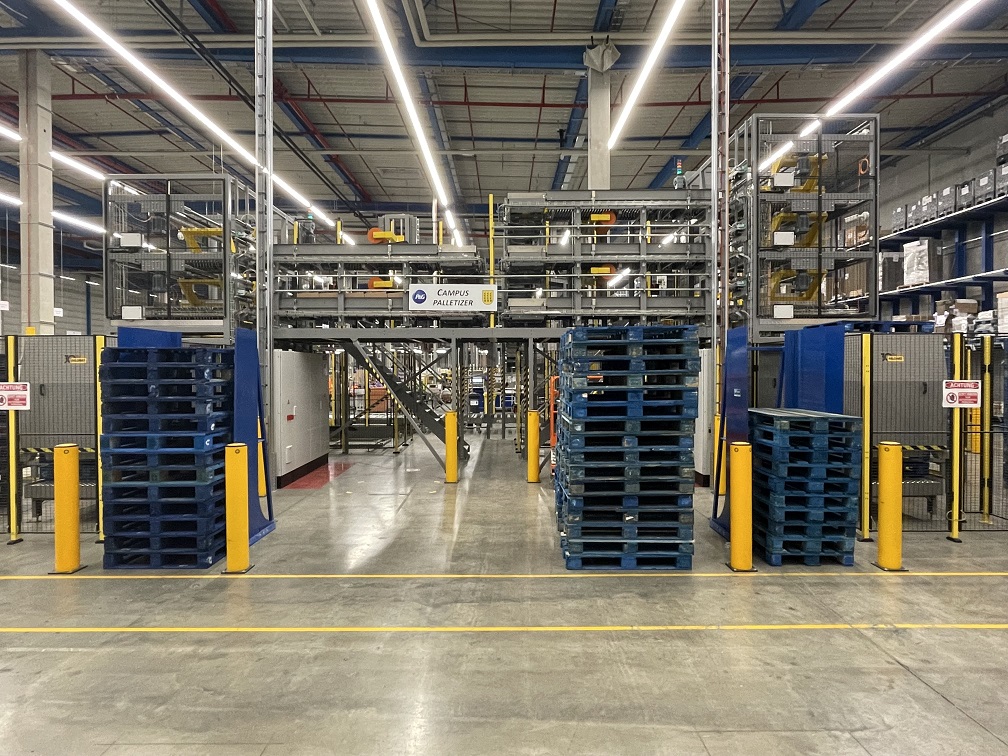
In a pallet straightener next to the dock, you place a crooked stack with the forklift and push it in with the forklift, which presses the stack straight. You then load the straight stack directly onto the lorry, or leave it in the frame for a while. Empty pallets then stand together, away from the traffic route, and everyone knows where they are.
The frame is only for empty pallets. It is not racking and it carries no goods.
Palletframe Auto: with a lead-in funnel
Palletframe Auto has a deeper lead-in funnel at the entry side, which makes the stack straighter. That is why the Auto is also called a pallet stack straightener or pallet aligner.
Palletframe Basic
Palletframe Basic is the standard model. In it, too, you press the stack of empty pallets straight with your forklift. Basic and Auto are both 2,350 mm high and made for a pallet width of 800, 1,000 or 1,200 mm.
What a pallet straightener at the dock does for you
-
Straight stacks
You press the stack straight with your forklift, so it stands stable and fits on the lorry.
-
A fixed place
Empty pallets stand together next to the dock, not scattered across the loading area.
-
A clear traffic route
Empty pallets stand in the frame, not in the forklift’s traffic route.
Which model fits?
You choose the model by the pallet width of your pallets: 800, 1,000 or 1,200 mm. On Pallet sizes you can see all models by pallet width. If you work with different pallet sizes, you can place a frame for each size; list them together in one request. For a non-standard size, we make the frame to measure.
Basic or Auto at the loading bay? We are happy to discuss which version suits your situation. Describe in the quote request where empty pallets build up at your site, and we will help you choose.
Frequently asked questions about empty pallets at loading and unloading
Another question?
We are happy to help.
Where should empty pallets go at the dock?
In a fixed place near the loading bay doors, away from traffic routes and walkways. A pallet straightener makes that place visible, and in it you press each stack straight with your forklift. Also agree who looks after the place.
Basic or Auto at the loading bay?
In both, you press a stack of empty pallets straight with your forklift. Palletframe Auto has a deeper lead-in funnel, which makes the stack straighter. Palletframe Basic is the standard model. We are happy to discuss which one suits your loading bay.
Can the frame be made for another pallet size?
Yes. Every line is available made to measure, with a non-standard pallet width or height. Include your pallet size, the height you need and the number of frames in the quote request. We agree the exact sizes with you.
Want a tidy dock?
Tell us which pallets you use and how many frames you need. You will receive a no-obligation quote.