

Article
Empty pallet storage without racking
For empty pallet storage you do not need racking: you can use loose stacks, block stacking on the floor or a pallet straightener. Block stacking takes the least floor space and in a pallet straightener each stack is pressed straight; the right choice depends on how many pallets you have and how often they come and go.
By Palletframe editorial team Published Updated
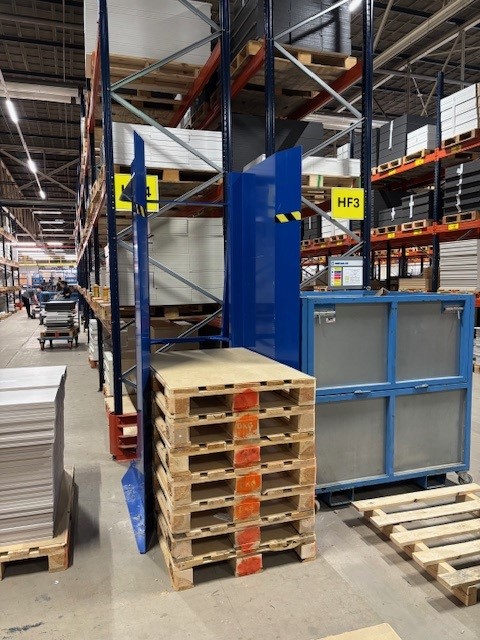
Every business that moves goods ends up with empty pallets. They have to wait somewhere until they are used again, collected or returned. Pallet racking is made for pallets with goods on them; for empty pallets, you usually choose storage on the floor. Below, we compare the options.
Storage on the floor does not have to be untidy. The difference lies in three things: a fixed place, straight stacks and clear arrangements. Each option below scores differently on those.
Three options for storing empty pallets
Loose stacks
The simplest option: empty pallets on top of each other, somewhere on the floor. You need nothing for it and you can start anywhere. The drawback is that loose stacks often have no fixed place. They appear wherever there happens to be space, start to lean and slowly creep into the walkways.
Loose stacks work fine as long as there are only a few and someone keeps an eye on things. With larger numbers or at busy times, it soon gets untidy. Stacks then stand where they are in the way, and nobody knows exactly how many empty pallets there are.
Block stacking
With block stacking, you place the stacks directly next to and behind each other on the floor, in a block, without aisles in between. It is a well-known way of storing loaded pallets, and it is also used for empty pallets.
The advantage is that you can fit a lot of pallets on little floor space. On the other hand, only the front stacks are easy to reach. A leaning stack in the middle of the block is hard to see and hard to get out, and a stack that falls over can hit other stacks. Block stacking therefore calls for discipline: a fixed area on the floor, straight rows and clear rules on which stack goes first.
Pallet straightener
A pallet straightener is a free-standing steel frame into which you place a stack of empty pallets with a forklift and push it in with the forklift, which presses the stack straight. The straight stack can stay in the frame, which marks the place where empty pallets belong. If you put several frames side by side, you get a clear storage zone with a fixed place for each stack.
Palletframe is made for a pallet width of 800, 1,000 or 1,200 mm, at the standard height (2,350 mm) and as the lower Store (1,300 mm). Every frame is blue as standard and available in another colour or galvanised as an option. If your pallet size is different, a made-to-measure frame is possible. You can see all models in the product overview.
The comparison
Which option suits you? The table puts the three side by side.
| Loose stacks | Block stacking | Pallet straightener | |
|---|---|---|---|
| Floor space | Varies: stacks are often scattered | Compact: little space between stacks | A fixed space per frame, matched to the pallet width |
| Order | No fixed place | Reasonable, as long as the block is kept tidy | Every stack has a fixed place |
| Straight stacks | Depends on the care taken when stacking | Depends on the care taken; stacks in the middle are hard to see | You press the stack straight with the forklift |
| Access | Good | Only the front stacks | Each frame can be reached separately with a forklift |
| Risk of toppling | Higher with tall or leaning stacks | A falling stack can hit others | Lower: the stack is pressed straight and stands stable |
| Investment | None | None, at most floor marking | Purchase of the frames, price on request |
In short: loose stacks suit small numbers, block stacking suits large numbers of pallets that stay put for a long time, and a pallet straightener suits a fixed, orderly place where pallets are regularly added and taken away. You can also combine the options, for example frames where empty pallets build up and a block for the large stock waiting to be collected.
Indoors or outdoors
Indoors, empty pallets stay dry and clean. That matters especially if the pallets are used again in production or with food. The drawback is that they take up floor space in the building that you could use for other things.
Outdoors there is often more space. Wooden pallets do get wet and dirty there, and wind can push against tall stacks. Also bear fire safety in mind: agree on the place and the distance from buildings and follow your company’s instructions. More on this in Storing empty wooden pallets with fire safety in mind.
A combination often works well. A small stock of empty pallets stays indoors, close to where they are needed again. The larger stock, for example pallets waiting to be collected or returned, stands outside. Here too, a fixed place with straight stacks helps to keep the yard orderly.
Thinking of using a pallet straightener outdoors? Ask us for advice on the version that suits your situation. Every frame is blue as standard and available in another colour or galvanised as an option. More on both situations in Stacking empty pallets in a warehouse and Outdoor pallet storage.
Tips for the floor space
Whichever option you choose, the place makes a big difference. Pay attention to these points:
- choose a place close to where empty pallets build up or are needed again, so the forklift does not make unnecessary trips;
- keep walkways, emergency exits and fire-fighting equipment clear;
- mark the storage zone on the floor, so it is clear where empty pallets belong;
- leave enough room to drive up straight with the forklift;
- give each pallet size its own place, so sizes do not get mixed up;
- set damaged pallets aside for repair or disposal;
- agree who looks after the storage place.
Also allow for busy moments. After a large delivery or at the end of the week, a lot of empty pallets often build up in a short time. If the storage place is not designed for that, loose stacks appear outside the fixed place after all. So plan some space for peaks.
How to stack empty pallets straight and stable is explained in Stacking empty pallets: straight, stable and safe. Want to know which frames suit your pallets and your floor? Request a no-obligation quote.
Frequently asked questions
Another question?
We are happy to help.
What is block stacking of pallets?
Block stacking is a way of storing pallets in which you place the stacks directly next to and behind each other on the floor, without racking and without aisles in between. You fit a lot of pallets on little floor space, but only the front stacks are easy to reach.
How do you store empty pallets without racking?
You can store empty pallets in loose stacks, by block stacking or in a pallet straightener. A pallet straightener is a free-standing steel frame in which you press the stack straight with a forklift; the straight stack can stay there, in a fixed place. Choose a level place away from walkways and give each pallet size its own place.
Can you store empty pallets outside?
Yes, but wooden pallets get wet and dirty outside, and wind can push against tall stacks. Follow your company’s fire safety rules for the location. If you want to use pallet straighteners outdoors, ask us for advice on the version. Every frame is blue as standard and available in another colour or galvanised as an option. See also Outdoor pallet storage.
Palletframe editorial team
This article was written by the Palletframe editorial team, based on Allmarec’s product data and hands-on experience.
-
Knowledge base
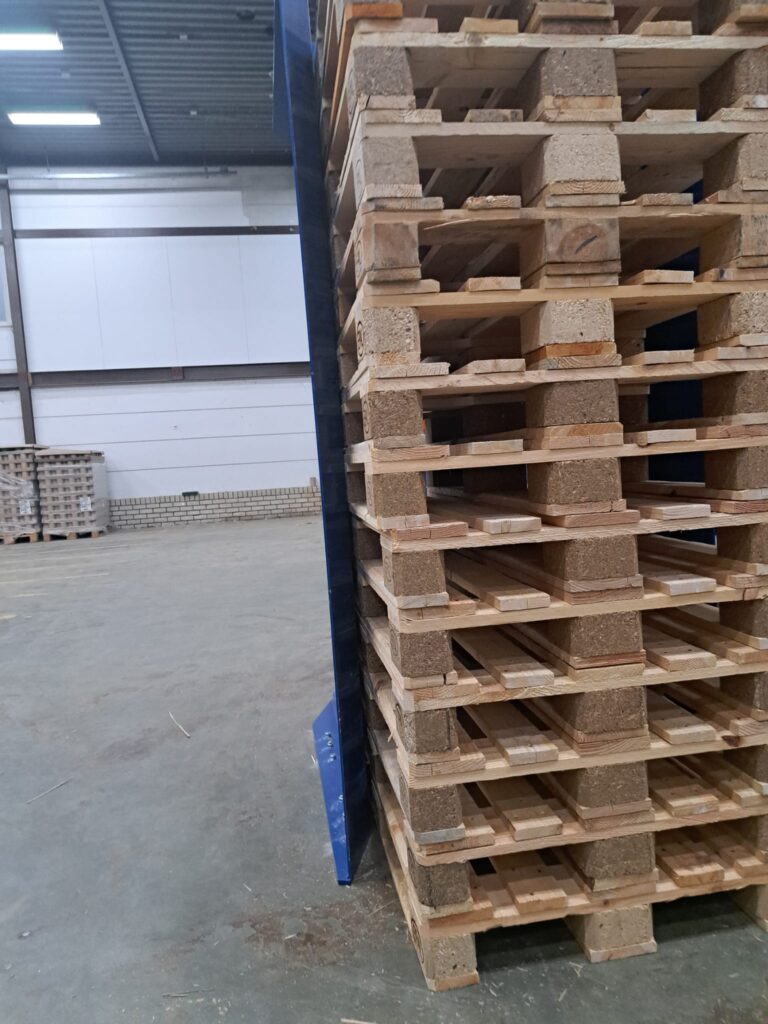
Stacking empty pallets: straight, stable and safe
You stack pallets straight and safely by stacking only whole empty pallets of the same size in a flat, fixed place and setting each…
Read more -
Blog
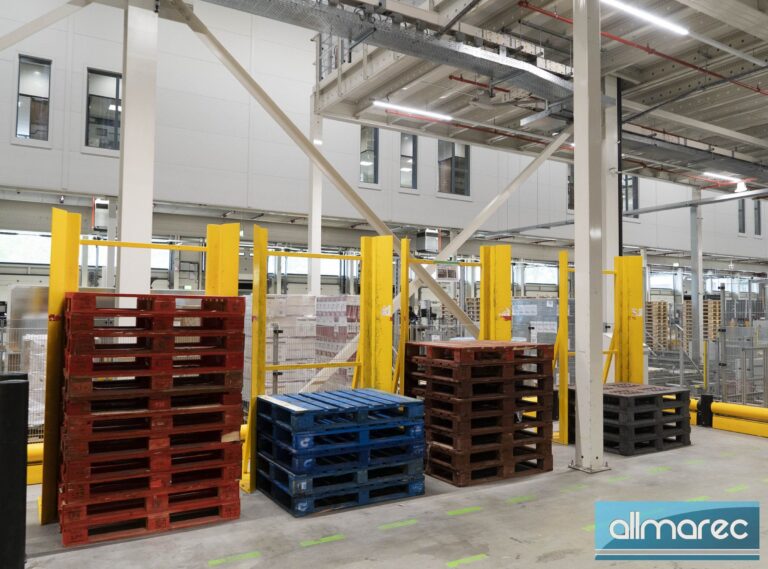
Empty pallets in a distribution centre: dock, buffer zone and floor space
Empty pallets in a distribution centre do not belong on the dock, but in a fixed buffer zone just behind the loading bays, away…
Read more -

Product line
Palletframe Basic
Palletframe Basic is a free-standing steel pallet stacking frame: you place a stack of empty pallets in it with a forklift and push it…
Read more
Questions about stacking empty pallets?
We are happy to help. Request a no-obligation quote or ask us your question.