

Article
Stacking empty pallets: straight, stable and safe
You stack pallets straight and safely by stacking only whole empty pallets of the same size in a flat, fixed place and setting each pallet squarely on the one below. Keep the stack within the height your company has set, and press crooked stacks straight with a forklift in a pallet straightener.
By Palletframe editorial team Published Updated
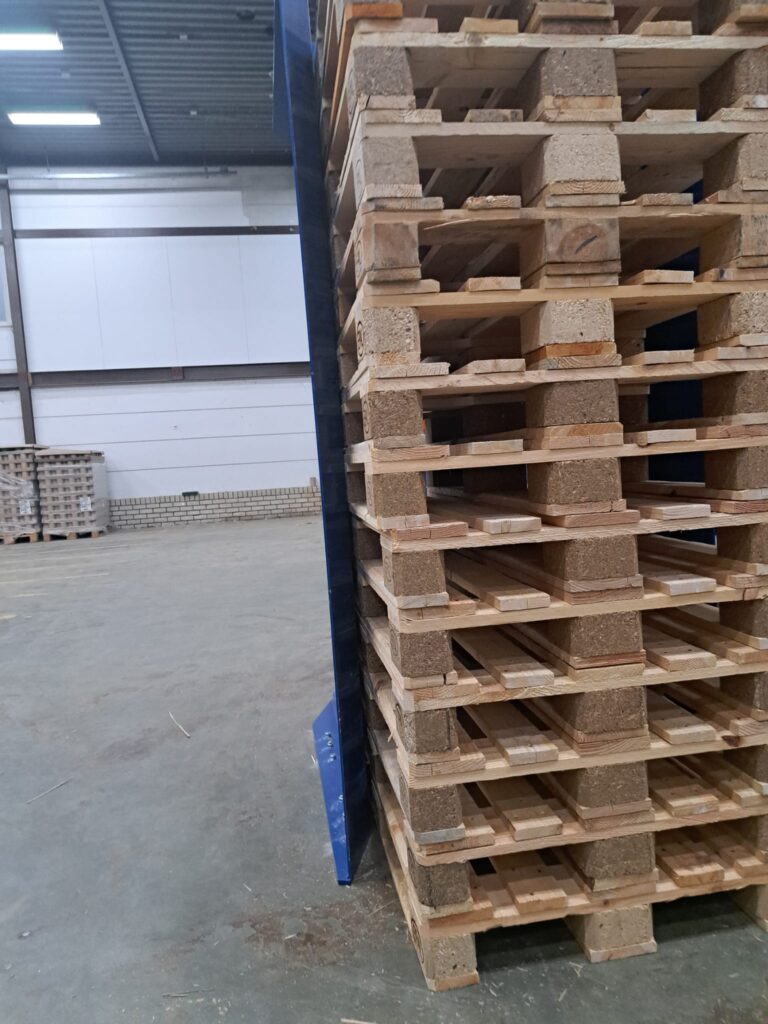
This article is about stacking empty pallets themselves, not about stacking goods on a pallet. It explains why stacks of empty pallets lean, how to prevent that step by step, what the rules and guidance say and which aids help.
Why stacks of empty pallets lean
A stack of empty pallets looks solid, but small deviations add up. If every pallet sits slightly off the one below, the stack is already well out of line at the top. The higher the stack, the more that matters.
The most common causes:
- Stacking in a hurry: the pallet is dropped on top quickly, without lining it up properly.
- Different pallets mixed together: a pallet of another size or design never sits properly on the rest of the stack.
- Damaged pallets: a broken board or a loose block makes the stack uneven.
- An uneven floor: a slope, a threshold or a dip tilts the whole stack.
- Cramped storage: with little space around the stack, it is hard to drive up to it straight.
- Knocks during work: a forklift or pallet truck that touches the stack pushes it out of line.
A leaning stack is more than an untidy sight. Pallets can slide or fall off the stack, and a whole stack can topple over. That means damage to pallets and equipment, and danger for anyone working nearby.
A leaning stack also costs time. Someone has to straighten it or rebuild it before more pallets can be added. A forklift driver who needs to pick up a leaning stack has to manoeuvre more carefully. And pallets that fall off a stack are more likely to be damaged, and sometimes cannot be used again.
How to stack empty pallets straight
These six steps help you build a straight, stable stack of empty pallets. They apply whether you stack with a forklift or by hand.
Step 1: choose a fixed, level place
Stack on a level, firm floor, away from walkways, traffic routes and emergency exits. Give empty pallets a fixed place, so everyone knows where they belong and no loose stacks appear around the building. Marking the place on the floor makes it easy to recognise. Choose the place so that the forklift can drive straight up to it, without having to turn or reverse just in front of the stack.
Step 2: sort by size and type
Only stack pallets of the same size and the same type on top of each other. If you use several pallet sizes, give each size its own stack and its own place. Even pallets of the same size can differ in design and height. If they are mixed, they do not sit properly on each other and the stack starts to slide sooner.
Step 3: check every pallet
Look at every pallet before it goes on the stack. A pallet with a broken board, a loose block or protruding nails does not belong on the stack; set it aside for repair or disposal.
Step 4: set each pallet squarely on the one below
Line up each pallet with the pallet below, at the front and at the side. If you use a forklift, drive up straight, keep the forks level and set the pallets down gently. After setting a pallet down, take a quick look along the side of the stack. You will see any deviation straight away and can correct it before the next pallet goes on.
Step 5: stay within the agreed height
Do not build the stack higher than the height agreed in your company. How that height is set is explained in How high can you stack empty pallets?.
Step 6: check the stacks regularly
Walk past the stacks, for example at the end of each shift. If a stack is leaning, straighten it before any more pallets are added. Agree who does this. If everyone assumes someone else will deal with it, a leaning stack often stays put for too long.
Safe stacking: the rules
Safe stacking falls under the general rules for health and safety at work. They put the responsibility on the employer, who assesses the risks and makes sure there are measures and instructions.
What the law asks
In the UK, the Health and Safety Executive (HSE) explains that under the Management of Health and Safety at Work Regulations 1999 the minimum you must do is identify what could cause injury or illness in your business, decide how likely it is that someone could be harmed and how seriously, and take action to eliminate the hazard or control the risk (Managing risks and risk assessment at work, HSE). Stacks of pallets that could fall over are one of those hazards.
In Ireland, section 19 of the Safety, Health and Welfare at Work Act 2005 requires every employer to identify the hazards in the place of work, assess the risks and have a written risk assessment. Section 20 adds a written safety statement based on that assessment. Where to find the official sources is explained in How high can you stack empty pallets?.
What HSE guidance says about pallets
The HSE guide Warehousing and storage: A guide to health and safety (HSG76) has a section on the safe use of pallets. Among other things, it says:
- you should have an effective system for pallet inspection, and damaged pallets should be removed from use;
- all pallets should be inspected each time before use, and damaged pallets withdrawn for repair or destruction;
- empty pallets should be handled carefully and not dragged or thrown about;
- only authorised, trained and competent people should operate lift trucks;
- operators should be instructed to keep the forks level, enter the pallet squarely and place loads carefully and gently on the stack below.
What this means in practice
What this means for your stacks is set out in your own company’s instructions. In practice, they usually come down to rules like these:
- only stack whole, undamaged pallets of the same size;
- stack on a level, firm surface and in a fixed place;
- keep walkways, emergency exits and fire-fighting equipment clear;
- do not build stacks higher than the company instruction allows;
- never climb onto a stack of pallets;
- leave stacking with a forklift to staff who are trained for it.
Stacking by hand
Not every stack is built with a forklift. If you put empty pallets on a stack by hand, take extra care. Avoid lifting above shoulder height, do not climb onto the stack to add one more pallet, and ask for help or use a lifting aid if the pallet is heavy to lift. A stack that is built by hand will naturally stay lower as a result.
Not sure whether your way of stacking is right? Check with your supervisor or the person responsible for health and safety in your company.
Aids: loose stacks or a pallet straightener
Careful stacking helps, but stacks still end up crooked. For empty pallets, there are roughly three options.
A loose stack
A loose stack on the floor costs nothing. Whether it ends up straight depends entirely on the care taken when stacking. It is precisely at busy times, when pallets have to be added quickly, that this often goes wrong.
Add-ons for a single pallet: a different product
Rims and corner boards that sit on top of a pallet are used with pallets that carry goods. They turn the pallet into a kind of box. For a stack of empty pallets, they do not solve the problem of leaning stacks. The difference is explained in What is a pallet straightener?.
A pallet straightener
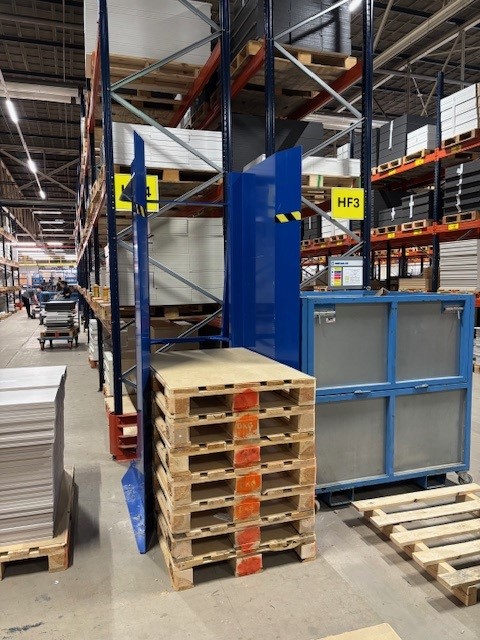
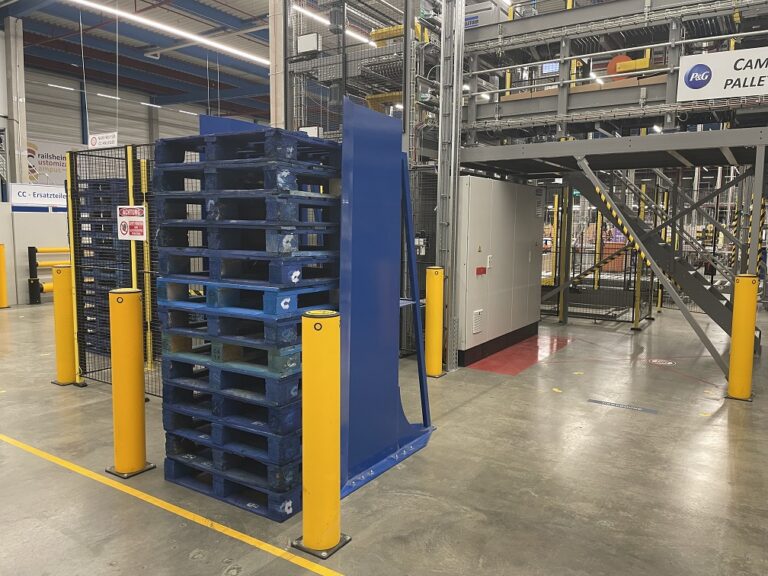
A pallet straightener is a free-standing steel frame that you place the stack of empty pallets into with a forklift. You then push the stack in with the forklift, which presses it straight. Palletframe Basic is the standard version. Palletframe Auto has a deeper lead-in funnel, which makes the stack straighter.
The difference from a loose stack shows most when things get busy. With a loose stack, every driver has to make sure on every trip that the pallets land exactly right. In a frame, one push with the forklift presses a crooked stack straight. That makes a straight stack less dependent on who is driving and how busy it is.
For more benefits, see the benefits of a pallet straightener. Want to know which frame fits your pallets? Request a no-obligation quote.
Frequently asked questions
Another question?
We are happy to help.
How do you stack pallets on top of each other?
Stack only whole empty pallets of the same size and type, on a level, fixed place. Line up each pallet with the one below at the front and the side, and check the stack regularly. In a pallet straightener, you press a crooked stack straight with your forklift.
Can you stack pallets on top of each other?
Yes, empty pallets of the same size and type can be stacked on top of each other, as long as they are undamaged, the floor is level and the stack stays within the height your company has set. Make sure the stack is straight; in a pallet straightener, you press it straight with your forklift.
How do you stack pallets with a forklift?
Drive up to the stack straight, keep the forks level and set each pallet down gently, squarely on the one below. HSE guidance HSG76 also says that only authorised, trained and competent people should operate lift trucks. In a pallet straightener, you then press the stack straight with the forklift; in a Palletframe Auto, the deeper lead-in funnel makes the stack straighter.
How high can you stack empty pallets?
As high as your company has set in its risk assessment and work instructions for that storage place. That height depends on the stability of the stack, the pallets, the floor and the equipment. Read more in How high can you stack empty pallets?.
Palletframe editorial team
This article was written by the Palletframe editorial team, based on Allmarec’s product data and hands-on experience.
-

Knowledge base
How high can you stack empty pallets?
How high you can stack empty pallets in a warehouse is set by your own company, in its risk assessment and work instructions for…
Read more -
Knowledge base
Empty pallet storage without racking
For empty pallet storage you do not need racking: you can use loose stacks, block stacking on the floor or a pallet straightener. Block…
Read more -
Product line
Palletframe Auto
Palletframe Auto is a pallet stack straightener: a free-standing steel frame with a deeper lead-in funnel. You place the stack of empty pallets in…
Read more -

Product line
Palletframe Basic
Palletframe Basic is a free-standing steel pallet stacking frame: you place a stack of empty pallets in it with a forklift and push it…
Read more
Questions about stacking empty pallets?
We are happy to help. Request a no-obligation quote or ask us your question.