

Article
How high can you stack empty pallets?
How high you can stack empty pallets in a warehouse is set by your own company, in its risk assessment and work instructions for each storage place. That height depends on the stability of the stack, the condition of the pallets, the floor and the equipment you use.
By Palletframe editorial team Published Updated

It is a question that comes up again and again: how high can a stack of empty pallets actually go? The answer lies with your own company. This article explains who sets the height, where to find guidance, what the height depends on and how to keep a tall stack stable.
What do the rules say?
How high you can safely stack empty pallets is set by your company in its risk assessment and work instructions. The rules put the responsibility on the employer: the employer assesses the risks in the business and takes measures, and the permitted stack height is one of those measures. Other rules, for example on fire safety, can add their own requirements.
United Kingdom
In the UK, the Health and Safety Executive (HSE) explains that under the Management of Health and Safety at Work Regulations 1999 the minimum you must do is identify what could cause injury or illness in your business, decide how likely it is that someone could be harmed and how seriously, and take action to eliminate the hazard or, if that is not possible, control the risk (Managing risks and risk assessment at work, HSE). Pallets falling from a stack, or a stack that topples over, are risks of that kind.
For warehouses, the HSE guide Warehousing and storage: A guide to health and safety (HSG76) explains how to do this. It describes risk assessment in five steps, from identifying the hazards to reviewing the assessment, and says that if you employ five or more people you must keep a record of the significant findings. The outcome feeds into instructions for the shop floor, such as a maximum stack height for each storage place.
HSG76 also gives guidance on the height of block stacks, as a ratio between the height of the stack and the minimum depth or width of the pallet. Note that this guidance is written for block stacking of palletised loads, so pallets with goods on them; HSG76 gives no separate height for stacks of empty pallets.
Ireland
In Ireland, section 19 of the Safety, Health and Welfare at Work Act 2005 requires every employer to identify the hazards in the place of work under their control, assess the risks presented by those hazards and be in possession of a written risk assessment (section 19 in the revised Act, Law Reform Commission). Section 20 requires a written safety statement based on that risk assessment (section 20).
The Health and Safety Authority (HSA) sums it up: employers must examine and write down the risks in the workplace and what to do about them, and the results of risk assessments should be written into the safety statement (Safety Statement and Risk Assessment, HSA). Here too, the permitted height follows from the assessment of your own situation.
In short: the right height is the height set in your company. If you do not know what it is, ask your supervisor or the person responsible for health and safety.
Why the height differs from place to place
A safe stack height depends on the situation. A stack of empty pallets on a level floor in a quiet corner is different from the same stack next to a busy traffic route or outside in a yard. The pallets themselves also differ: in size, in design and in condition. That is why your company sets the height for each of its own storage places, rather than one height for everything.
Putting it into practice
An agreed height only works if everyone knows it. Make the height visible at the storage place, for example with a mark on the wall or a sign. Put it in the work instructions and in the induction for new staff and agency workers. And agree who checks that stacks do not go higher than agreed.
What the stack height depends on
When your company decides on a safe height, it looks at more than the stack itself. These factors play a part:
- The stability of the stack: a straight stack is more stable than a leaning one. The higher the stack, the more a small lean matters.
- The condition and type of the pallets: damaged pallets or different sizes mixed together make a stack less stable.
- The floor: a level, firm floor is needed. A slope or an uneven surface tilts the whole stack.
- The equipment: the lift height of the forklift and the driver’s view determine up to what height you can safely add and remove pallets.
- Stacking by hand: if you stack by hand, do not stack higher than you can safely reach without climbing or stretching.
- The surroundings: forklift and pedestrian traffic, the clear height in the building, lighting and fire safety all count.
- Outdoor storage: outside, wind can push against a tall stack, and the ground becomes less firm when it rains.
How to keep a tall stack stable
The taller the stack, the more important it is that it stands straight. These measures help you keep a taller stack stable as well:
- only stack whole pallets of the same size and type on top of each other;
- set each pallet squarely on the one below, at the front and at the side;
- choose a fixed place on a level floor, away from forklift routes;
- do not let a stack lean against a wall or another stack;
- check the stacks regularly and straighten a leaning stack before more pallets are added;
- press crooked stacks straight with a forklift in a pallet straightener.
Pay particular attention to the bottom pallets. They carry the whole stack. If one of them is damaged or sits at an angle, that carries through to the top. It is better to rebuild a stack than to keep stacking on a poor base.
For a step-by-step guide to stacking straight, see Stacking empty pallets: straight, stable and safe.
Heights of a pallet straightener
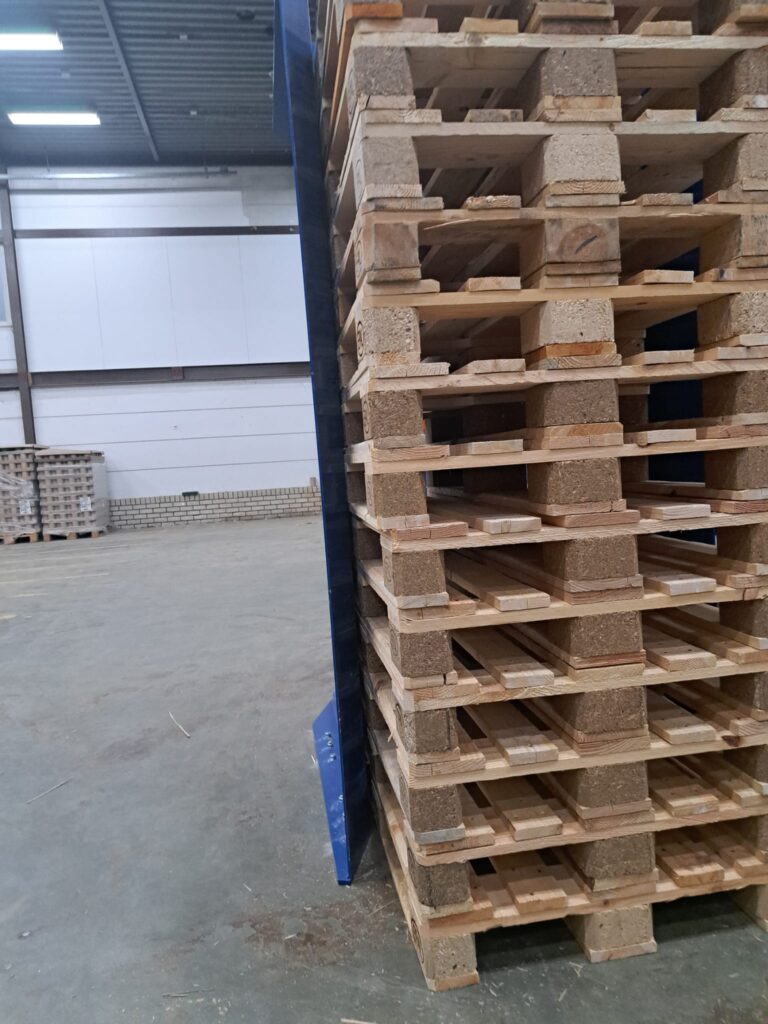
A pallet straightener is a free-standing steel frame into which you place a stack of empty pallets with a forklift and push it in with the forklift, which presses the stack straight. Note that the height of the frame is not the same as the stack height your company allows. Your own limit still applies.
A frame does help with stability, one of the factors that determine the safe height: a stack that has been pressed straight is more stable than a crooked stack of the same height. So choose the height of the frame to suit the space in your building and the stack height you have agreed.
| Version | Pallet width | Frame height |
|---|---|---|
| Palletframe Basic (B800, B1000, B1200) | 800, 1,000 or 1,200 mm | 2,350 mm |
| Palletframe Auto (A800, A1000, A1200) | 800, 1,000 or 1,200 mm | 2,350 mm |
| Palletframe Store S1200 | 1,200 mm | 1,300 mm |
| Made to measure (every line) | on request | on request |
The standard frames, such as Palletframe Basic, are 2,350 mm high. If there is less height available, take a look at Palletframe Specials: the Store S1200 is the low version at 1,300 mm. To find the right width for your pallets, see Pallet sizes.
How many pallets fit in a frame depends on the height of your pallets. Get in touch and we will look at what suits your situation.
Frequently asked questions
Another question?
We are happy to help.
What is the maximum pallet stack height?
For empty pallets, the maximum is the height your company has set for each storage place in its risk assessment and work instructions. It depends on the stability of the stack, the condition of the pallets, the floor, the forklift and the surroundings. A stack that has been pressed straight is more stable than a crooked, leaning stack.
What are the pallet stacking regulations?
In the UK, the Management of Health and Safety at Work Regulations 1999 require employers to identify hazards, assess the risk and control it (HSE). In Ireland, sections 19 and 20 of the Safety, Health and Welfare at Work Act 2005 require a written risk assessment and a safety statement. The safe stack height for empty pallets follows from that assessment and your work instructions.
What does the HSE say about pallet stacking?
The HSE guide HSG76, Warehousing and storage says you should have an effective system for pallet inspection, remove damaged pallets from use and handle empty pallets carefully, without dragging or throwing them. Its stack height ratio is written for block stacking of palletised loads; HSG76 gives no separate figure for empty pallets. The height for empty pallets follows from your own risk assessment.
How tall is a pallet straightener?
Palletframe Basic and Palletframe Auto are 2,350 mm high. At 1,300 mm, the Store S1200 is the low version. Every line is also available made to measure. See Palletframe Specials for the low version.
Palletframe editorial team
This article was written by the Palletframe editorial team, based on Allmarec’s product data and hands-on experience.
-
Knowledge base
Stacking empty pallets: straight, stable and safe
You stack pallets straight and safely by stacking only whole empty pallets of the same size in a flat, fixed place and setting each…
Read more -
Blog
Storing empty wooden pallets with fire safety in mind
You store empty wooden pallets fire-safely by keeping the stock limited, giving the stacks a fixed place away from ignition sources and keeping escape…
Read more -
Product line
Palletframe Specials
Palletframe Specials: the low Store S1200 at 1,300 mm or the Flat F1200, a flat frame, both for a pallet width of 1,200 mm.…
Read more
Questions about stacking empty pallets?
We are happy to help. Request a no-obligation quote or ask us your question.