

Post
Storing empty wooden pallets with fire safety in mind
You store empty wooden pallets fire-safely by keeping the stock limited, giving the stacks a fixed place away from ignition sources and keeping escape routes and fire-fighting equipment clear. The exact requirements follow from your fire risk assessment and the fire safety rules for your premises.
By Palletframe editorial team Published Updated
Many businesses keep empty wooden pallets: in the building, by the dock or outside in the yard. They look harmless, but a stock of dry timber is also combustible material.
This article explains why empty wooden pallets are a fire risk, what the rules in the UK and Ireland say, what to look out for when storing them indoors and outdoors, and how order on the floor helps.
Why empty wooden pallets are a fire risk
A fire needs a source of ignition, fuel and oxygen. The HSE guide Warehousing and storage: A guide to health and safety (HSG76) names exactly these three as the fire hazards to identify in a fire risk assessment. A stock of dry wooden pallets is fuel.
HSG76 also gives a starting point for reducing the risk: at its simplest, separating flammable and combustible materials from ignition sources. Points to consider include housekeeping, such as preventing the accumulation of combustible materials, and the storage of combustible materials, with sufficient storage areas that are controlled and monitored. The guide also mentions arson as a significant risk, particularly if combustible rubbish is stored alongside the building.
A fire in a pallet store can also affect more than the pallets: the building, goods and vehicles nearby, and with them the work in your business.
What do the rules say?
Which rules apply to your storage depends on your premises, your activities and where you are based. Below are the official sources to start with.
United Kingdom
According to the HSE, the Regulatory Reform (Fire Safety) Order covers general fire safety in England and Wales; in Scotland, the requirements are in Part 3 of the Fire (Scotland) Act, supported by the Fire Safety (Scotland) Regulations. Employers, building owners or occupiers must carry out a fire safety risk assessment and keep it up to date, and in most premises the local fire and rescue authorities enforce this legislation (Introduction to fire safety, HSE).
The government guide Fire safety risk assessment: factories and warehouses (England and Wales) lists plastic and timber storage aids “both in use and idle, such as pallets” among the common sources of fuel. It warns that “even piles of wooden pallets can introduce severe fire hazards”. For outdoor storage, it advises siting goods, materials, pallets and vehicles in designated storage areas away from the building, fire exits, windows and boundary fences, and keeping outdoor areas tidy by clearing waste and vegetation.
GOV.UK explains that the person responsible for the premises, the “responsible person”, must among other things carry out a fire risk assessment and review it regularly, put in place and maintain suitable fire safety measures, plan for emergencies and give staff fire safety information, instruction and training. There are different rules on fire safety in Scotland and Northern Ireland (Fire safety in the workplace, GOV.UK).
Ireland
In Ireland, section 18(2) of the Fire Services Act 1981, as amended in 2003, places a duty on every person having control over premises to take all reasonable measures to guard against the outbreak of fire, to provide reasonable fire safety measures and procedures, to make sure they are applied at all times and, as far as is reasonably practicable, to ensure the safety of people on the premises in the event of a fire. Since the 2003 amendment, this applies to all premises other than a single private dwelling, including workplaces (Licensing of Indoor Events Act 2003, section 29; see also Donegal County Council).
In addition, the Safety, Health and Welfare at Work Act 2005 requires every employer to identify the hazards in the place of work and have a written risk assessment (section 19). Empty wooden pallets belong in that assessment too.
In short: empty wooden pallets belong in your fire risk assessment. Decisions on location, quantity and distance follow from it and from the rules for your premises. If in doubt, ask your fire safety adviser or the local fire and rescue service. For stack height from a stability point of view, see How high can you stack empty pallets?.
Storing indoors or outdoors
Indoors
Indoors, pallets stay dry and clean, but a stack of dry timber in the building is also combustible material in your premises. Pay attention to these points:
- keep the stock indoors limited to what you need in the short term;
- keep escape routes, emergency exits and fire-fighting equipment clear;
- keep a distance from ignition sources, such as naked flames, heaters and work that produces sparks;
- store empty pallets low, on the floor, rather than high up in racking;
- make sure the stacks are straight, so they do not fall into a walkway.
Outdoors
Outdoors, the combustible stock is not inside your building. Even so, a fire can start there too, and the flames can then spread to buildings, vehicles or other storage nearby. That is why the place in the yard matters:
- choose a designated place away from the building, fire exits, windows and boundary fences, as the government fire safety guide for factories and warehouses advises, and keep it clear of other storage;
- leave space between groups of stacks, so a fire spreads less easily;
- keep access clear for the fire and rescue service;
- keep the area tidy and clear away waste and vegetation;
- make sure unauthorised people cannot easily get to the stacks.
How far from the building depends on your site, so we do not give a figure here. Ask your fire safety adviser or the local fire and rescue service. More about empty pallets outdoors in Outdoor pallet storage.
Order helps: a fixed place
Order on the floor helps fire safety. A fixed storage place with a designated boundary shows how many pallets there are. It also prevents stacks from slowly creeping into the escape route or the space for fire-fighting equipment.
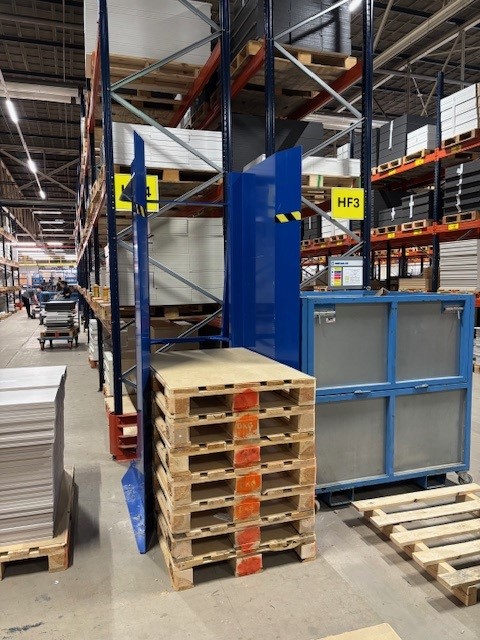
A pallet straightener can help with that. It is a free-standing steel frame in which you press a stack of empty pallets straight with a forklift. You can leave the straight stack in the frame, in a fixed place. The stacks stay within the designated zone and you can see at a glance whether the stock is growing larger than intended. Palletframe Basic is the standard model, for a pallet width of 800, 1,000 or 1,200 mm.
A pallet straightener does not make wooden pallets any less combustible. Rules on quantity, location and distance still apply, even when the stacks stand in a frame.
How to store empty pallets without racking, and how a frame compares with loose stacks and block stacking, is explained in Empty pallet storage without racking. Questions about a fixed place for your empty pallets? Get in touch.
Frequently asked questions
Another question?
We are happy to help.
How do you store wooden pallets safely?
Keep the stock limited, give the stacks a fixed place away from ignition sources and keep escape routes, emergency exits and fire-fighting equipment clear. Outdoors, choose a designated place away from the building, fire exits, windows and boundary fences. The exact requirements follow from your fire risk assessment and the fire safety rules for your premises.
How far from a building should pallets be stored?
We cannot give one distance for every business: it depends on your situation and follows from your fire risk assessment. The government fire safety guide for factories and warehouses (England and Wales) advises keeping pallets in designated storage areas away from the building, fire exits, windows and boundary fences (GOV.UK). In Ireland, the person in control of the premises has a general duty to guard against fire under the Fire Services Acts. Ask your fire safety adviser or the local fire and rescue service for advice.
What does UK fire safety guidance say about storing pallets?
The government guide Fire safety risk assessment: factories and warehouses (England and Wales) counts idle timber pallets among the common sources of fuel and warns that even piles of wooden pallets can introduce severe fire hazards. Outdoors, it advises keeping pallets in designated storage areas away from the building, fire exits, windows and boundary fences. How far away depends on your site and follows from your own fire risk assessment.
Palletframe editorial team
This article was written by the Palletframe editorial team, based on Allmarec’s product data and hands-on experience.
-

Knowledge base
How high can you stack empty pallets?
How high you can stack empty pallets in a warehouse is set by your own company, in its risk assessment and work instructions for…
Read more -
Knowledge base
Empty pallet storage without racking
For empty pallet storage you do not need racking: you can use loose stacks, block stacking on the floor or a pallet straightener. Block…
Read more -

Product line
Palletframe Basic
Palletframe Basic is a free-standing steel pallet stacking frame: you place a stack of empty pallets in it with a forklift and push it…
Read more
Questions about stacking empty pallets?
We are happy to help. Request a no-obligation quote or ask us your question.