

Article
What is a pallet straightener?
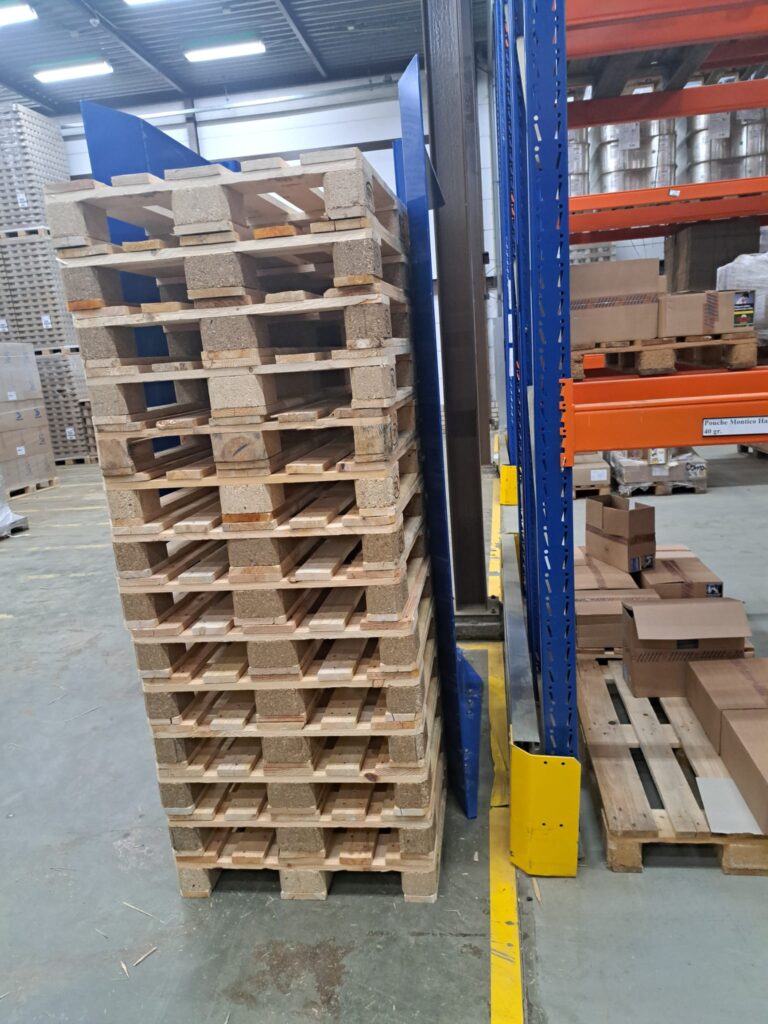
A pallet straightener is a free-standing steel frame in which you place a stack of empty pallets with a forklift and push it in with the forklift, which presses the stack straight so it stands stable. It has no drive: the forklift does the work, and the straight stack is ready for the lorry or the palletiser.
By Palletframe editorial team Published Updated
How a pallet straightener works
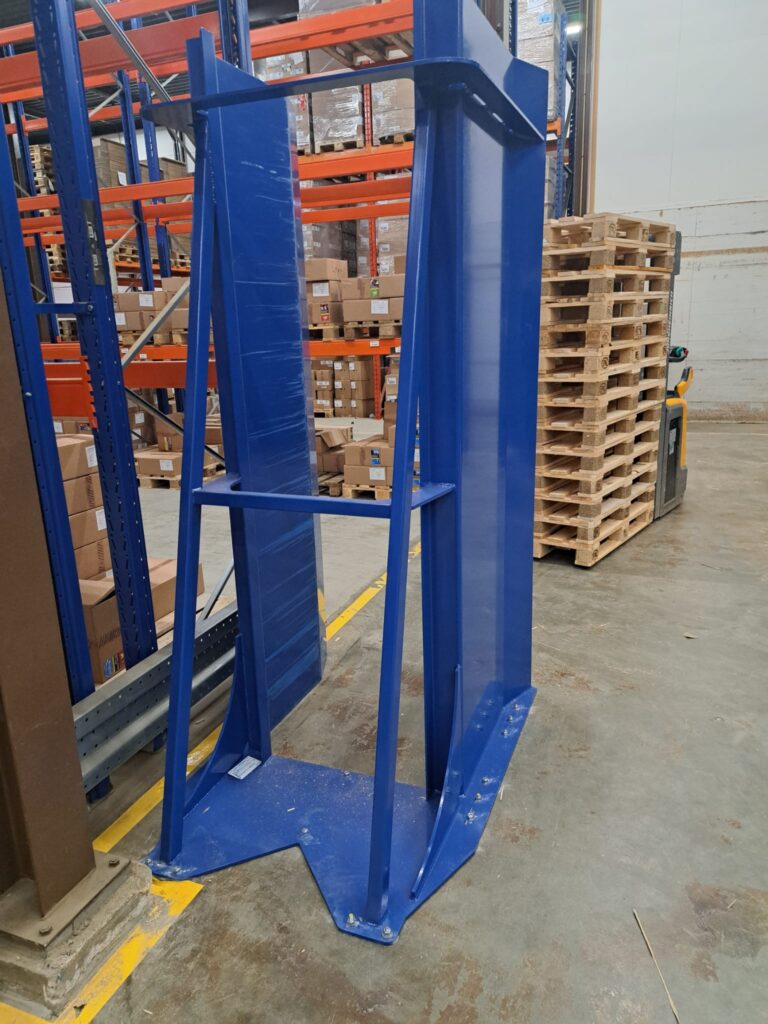
A pallet straightener is a free-standing steel frame. It is not racking and it does not carry goods. The frame has one job: in it, you press a crooked stack of empty pallets straight with your forklift.
Using it is simple. The forklift driver picks up a crooked stack of empty pallets, places it in the frame and pushes it in with the forklift. That presses the stack straight. The lead-in funnel at the entry side centres the pallets as they go in. Then the driver takes the straight stack out and puts it where it is needed: in the warehouse, directly onto the lorry, at the palletiser or on the conveyor into the automated warehouse.
Why is that needed? A stack of empty pallets soon ends up crooked: every pallet that is set down slightly off line makes the stack more crooked, until pallets stick out on the left and right. A stack like that is unstable and can topple over, and it does not fit on a lorry, in an automated warehouse or in a palletiser. In the frame, one push with the forklift presses the pallets back into line, so the precision no longer has to come from whoever built the stack.
What a pallet straightener does in practice:
- it turns a crooked stack into a straight, stable stack that is safer;
- the straight stack can go on directly: into storage, onto the lorry or into the palletiser;
- if you leave the stack in the frame for a while, the frame gives empty pallets a fixed place; several frames side by side give each type of pallet its own place.
A pallet straightener needs no motor, no controls and no power supply: the forklift does the work. That makes it something quite different from an empty pallet stacker, which is really a pallet dispenser: the operator takes a pallet out or puts one back. You can read how the two compare in Pallet straightener or empty pallet stacker.
Pallet straightener, pallet frame or pallet collar: the difference
Several names are used for products around stacks of pallets. Some mean the same as a pallet straightener; others describe a completely different product. These are the terms you will come across most often.
Pallet frame and pallet stacking frame
“Pallet frame” is a broader name. Palletframe uses it for the same product, a frame for stacks of empty pallets, but the term is also used for frames that sit on or around a loaded pallet. That is why we always add “for empty pallets”.
The same goes for “pallet stacking frame”. In the UK, pallet stacking frames are often steel frames that let you stack loaded pallets on top of each other. A Palletframe is not one of those: it carries no goods and is meant only for stacks of empty pallets.
Pallet aligner and pallet stack straightener
Pallet aligner and pallet stack straightener are other names for a frame in which you press a stack of empty pallets straight. The names describe what you do with the frame. At Palletframe, they are used most for Palletframe Auto: that model has a deeper lead-in funnel, which makes the stack straighter. In Palletframe Basic, too, you press the stack straight with your forklift.
Pallet collar
A pallet collar is a different product. It is a rim, usually made of wood, that you place on top of a pallet so that the pallet becomes a kind of open box for loose goods. Pallet collars belong with loaded pallets.
A pallet straightener has nothing to do with that. It is a free-standing frame, no goods go in it and it is meant only for stacks of empty pallets. If you are looking for a way to keep goods together on a pallet, a pallet straightener is not the answer.
The models: Basic, Auto and Specials
Palletframe comes in three lines. Basic and Auto are made for a pallet width of 800, 1,000 or 1,200 mm and are 2,350 mm high. The Specials are two special models for a pallet width of 1,200 mm: the low Store and the Flat, a flat frame. The number in the model code is the pallet width in millimetres.
| Model | Line | Pallet width | Height | Article number |
|---|---|---|---|---|
| B800 | Basic | 800 mm | 2,350 mm | 13022002 |
| B1000 | Basic | 1,000 mm | 2,350 mm | 13022004 |
| B1200 | Basic | 1,200 mm | 2,350 mm | 13022001 |
| A800 | Auto | 800 mm | 2,350 mm | 13002028 |
| A1000 | Auto | 1,000 mm | 2,350 mm | 13002027 |
| A1200 | Auto | 1,200 mm | 2,350 mm | 13002030 |
| Store S1200 | Specials | 1,200 mm | 1,300 mm | 13022025 |
| Flat F1200 | Specials | 1,200 mm | 2,600 mm (stack of boxes) | 13002015 |
Every frame is blue as standard. As an option, it is available in another colour or galvanised. If your pallet size is different, or you need another height, every line is also available made to measure.
Palletframe Basic
Palletframe Basic is the standard model: a free-standing frame in which you press a stack of empty pallets straight. You place the stack in the frame with a forklift and push it in with the forklift.
Palletframe Auto
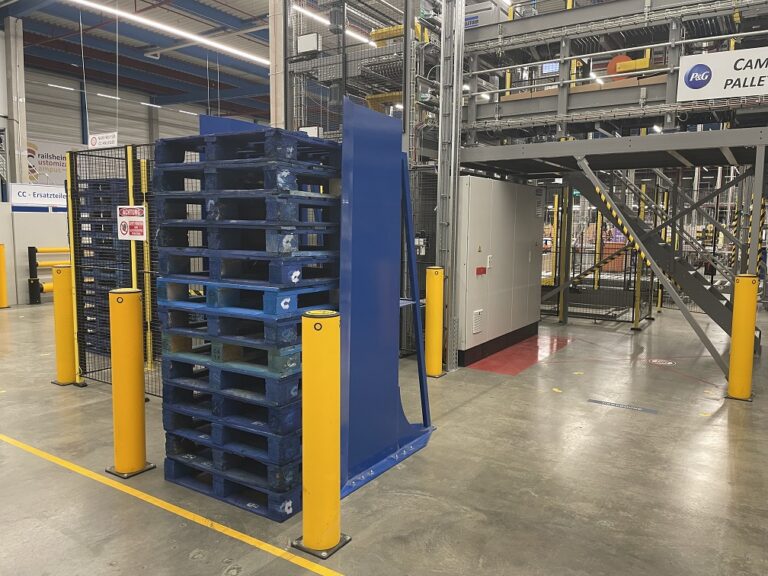
Palletframe Auto has a deeper lead-in funnel, which makes the stack straighter. The Auto also works without any drive: it is a steel frame, not a machine.
Palletframe Specials
The Specials are two special models. The Store S1200 is the low version, with a height of 1,300 mm. The Flat F1200 is a flat frame with a different application: against it, you press a crooked stack of boxes on a pallet straight.
How to choose a model
You choose a pallet straightener in three steps:
- choose the pallet width that matches your pallets: 800, 1,000 or 1,200 mm, or made to measure;
- choose the height: the standard height of 2,350 mm or the lower Store;
- choose the finish: blue as standard, another colour or galvanised.
To find the right width for your pallets, see Pallet sizes. You can see all models side by side in the product overview.
When do you use a pallet straightener?
A pallet straightener is useful wherever stacks of empty pallets have to be straight before they go on: into storage, onto a lorry or into a palletiser. A few examples:
- in the warehouse and the distribution centre, where empty pallets are left over after unpacking or order picking;
- in production, where a supply of empty pallets has to be ready for the line;
- at the loading bay, where empty pallets come back or are made ready for transport.
The same thing happens in all of these places: empty pallets are a by-product of the work. Their stacks soon end up crooked. A pallet straightener turns that around: the forklift presses each stack straight in the frame. And because the frame stands in a fixed, designated place, everyone knows where empty pallets go.
Sound familiar? Crooked stacks that lean, pallets that stick out or slide off, stacks that do not fit on the lorry: a pallet straightener is the logical next step. You will find examples for each situation under Applications.
Not sure which model suits your pallets and your space? Request a no-obligation quote and we will help you choose.
Frequently asked questions
Another question?
We are happy to help.
What is a pallet aligner?
A pallet aligner is another name for a frame in which you press a stack of empty pallets straight with a forklift. At Palletframe, the term is used most for Palletframe Auto: its deeper lead-in funnel makes the stack straighter.
Is a pallet straightener the same as a pallet collar?
No. A pallet collar is a rim that you place on a pallet to hold goods. A pallet straightener is a free-standing frame in which you press a stack of empty pallets straight with a forklift. No goods go in it.
What sizes does a pallet straightener come in?
Palletframe Basic and Palletframe Auto are made for a pallet width of 800, 1,000 or 1,200 mm and are 2,350 mm high. The Store S1200 is 1,300 mm high, for a pallet width of 1,200 mm. The Flat F1200 is a flat frame for a stack of boxes on a pallet. Every line is also available made to measure. How to choose the right width is explained on Pallet sizes.
Palletframe editorial team
This article was written by the Palletframe editorial team, based on Allmarec’s product data and hands-on experience.
-
Knowledge base
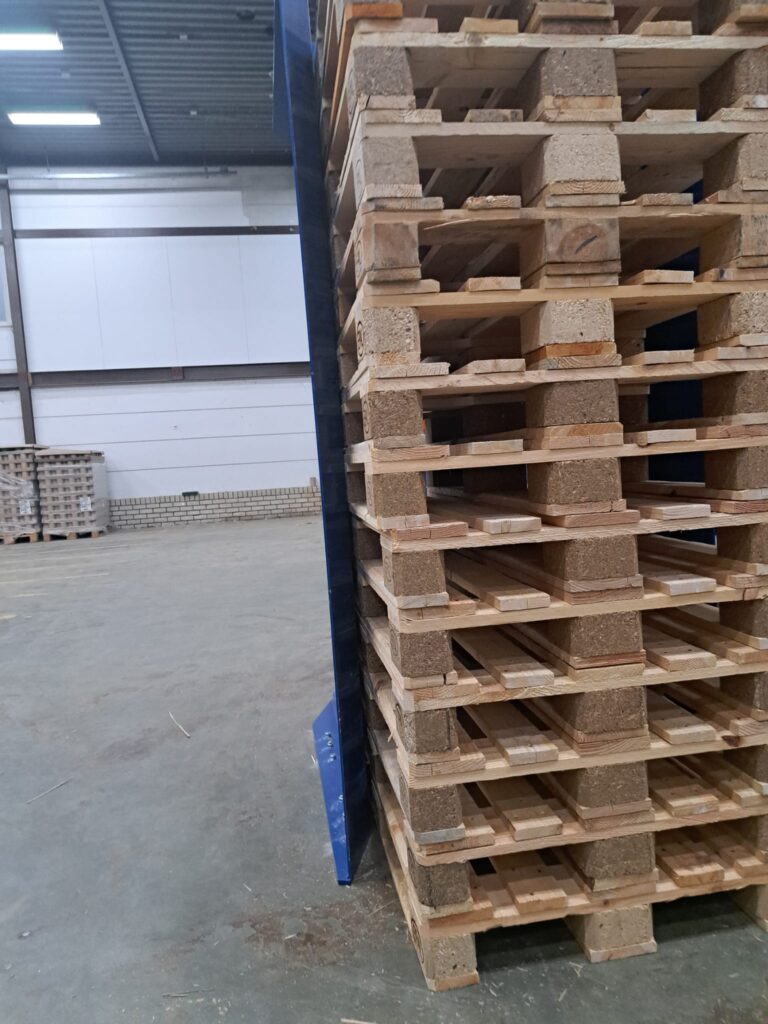
Stacking empty pallets: straight, stable and safe
You stack pallets straight and safely by stacking only whole empty pallets of the same size in a flat, fixed place and setting each…
Read more -
Knowledge base
Pallet straightener or empty pallet stacker: which suits your empty pallets?
An empty pallet stacker is really a pallet dispenser: operators take a pallet out or put one back. A pallet straightener is a free-standing…
Read more -

Product line
Palletframe Basic
Palletframe Basic is a free-standing steel pallet stacking frame: you place a stack of empty pallets in it with a forklift and push it…
Read more -
Product line
Palletframe Auto
Palletframe Auto is a pallet stack straightener: a free-standing steel frame with a deeper lead-in funnel. You place the stack of empty pallets in…
Read more
Questions about stacking empty pallets?
We are happy to help. Request a no-obligation quote or ask us your question.