

Article
Pallet straightener or empty pallet stacker: which suits your empty pallets?
An empty pallet stacker is really a pallet dispenser: operators take a pallet out or put one back. A pallet straightener is a free-standing steel frame in which a forklift presses a stack of pallets straight. Choose a dispenser if operators keep needing a new pallet, a straightener if stacks need pressing straight.
By Palletframe editorial team Published Updated
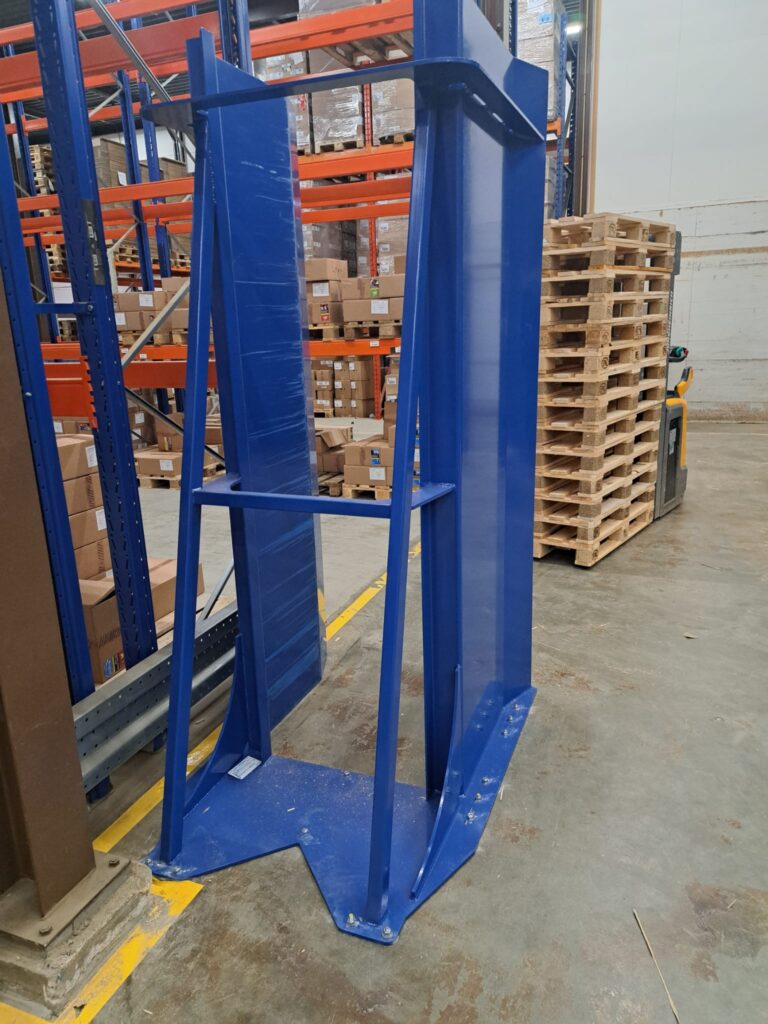
In the UK, “pallet stacker” often means a stacker truck. This article is about something else: the empty pallet stacker, also called a pallet dispenser or pallet magazine, compared with the pallet straightener. Both have to do with empty pallets, but they do something very different. One hands out single pallets, the other presses a whole stack straight. We set the two side by side, so you can decide what suits your situation.
What is an empty pallet stacker?
What is sold as an empty pallet stacker is really a pallet dispenser: the operator takes a pallet out or puts one back.
So an empty pallet stacker is about single pallets. The operator does not move a whole stack, but takes one pallet at a time. A pallet that is not needed after all can go back in.
An empty pallet stacker therefore fits best where operators constantly need a new pallet.
What an empty pallet stacker does not do is straighten a crooked stack. If your problem is stacks of empty pallets with pallets sticking out on the left and right, a dispenser is not the answer.
What is a pallet straightener?
A pallet straightener is a free-standing steel frame in which you press a stack of pallets straight with a forklift. You place a crooked stack of empty pallets in the frame with the forklift and push it in with the forklift. That presses the stack straight. The lead-in funnel at the entry side centres the pallets as they go in. There is no drive, no electronics and no controls: the forklift does the work. A full explanation is in What is a pallet straightener?.
Why would you press a stack straight? A stack of empty pallets soon ends up crooked, with pallets sticking out on the left and right. A stack like that is unstable and can topple over. It also does not fit on a lorry, in an automated warehouse or in a palletiser. A straight stack is safer and can go on directly.
After pressing, you take the straight stack out of the frame and put it where it is needed: in the warehouse, directly onto the lorry, at the palletiser or on the conveyor into the automated warehouse. You can also leave the stack in the frame for a while. Several frames side by side give each type of pallet its own fixed place.
Palletframe comes in three lines. Palletframe Basic is the standard version: in it, you press the stack straight with your forklift. Palletframe Auto works exactly like Palletframe Basic. The difference is the deeper lead-in funnel of the Auto. It makes the stack straighter, and that makes the Auto a better pallet straightener than the Basic. The play is the same on both models; only the depth of the funnel makes the difference. Basic and Auto are made for a pallet width of 800, 1,000 or 1,200 mm and are 2,350 mm high. The Specials are the low Store S1200 (1,300 mm) and the Flat F1200, a flat frame for a stack of boxes on a pallet. Every line is also available made to measure.
A pallet straightener does not hand out single pallets. It works with whole stacks: the forklift brings a stack, presses it straight in the frame and takes the straight stack away again.
That makes a pallet straightener especially useful in places where the forklift is driving anyway: in the warehouse, in production, at the loading bay or in the yard. The forklift keeps working in the same way. The only difference is that crooked stacks now leave the frame straight.
The comparison
The main differences at a glance. We do not mention prices: the price of a pallet straightener depends on the model and the number of frames.
| Empty pallet stacker | Pallet straightener | |
|---|---|---|
| What it does | Hands out pallets: the operator takes a pallet out and can put one back | Presses a stack of pallets straight |
| Who operates it, and how | The operator, one pallet at a time | The forklift driver: the forklift places the stack in the free-standing steel frame and presses it straight |
| What you handle | Single pallets | Whole stacks of empty pallets |
| Choose it if | Operators constantly need a new pallet | Stacks of pallets need to be pressed straight |
When to choose which
The choice depends mainly on the problem you want to solve. So first ask yourself these questions:
- Do operators constantly need a new pallet, one at a time?
- Or are your stacks of empty pallets crooked, with pallets sticking out on the left and right?
- Does the stack have to go onto a lorry, into an automated warehouse or into a palletiser afterwards?
- Does the forklift bring and collect the empty pallets as a stack?
The answers usually show which solution fits.
Choose an empty pallet stacker if…
- operators constantly need a new pallet;
- they take pallets out one at a time and sometimes put one back.
Choose a pallet straightener if…
- stacks of pallets need to be pressed straight;
- crooked stacks are unstable or do not fit on the lorry, in the automated warehouse or in the palletiser;
- the forklift brings empty pallets as a stack and collects them again;
- you want a steel frame without any drive, where the forklift does the work.
A pallet straightener is also a logical choice if you want straight stacks without changing the way you work. The frame goes where the crooked stacks are now, and the forklift keeps working in the same way.
Or both
An empty pallet stacker and a pallet straightener do not rule each other out, because they solve different problems. The dispenser hands out single pallets to operators; the pallet straightener turns crooked stacks into straight ones. If you have both problems, you can use both. You will find examples of places where a pallet straightener is used under Applications.
Not sure what suits your situation? Describe how empty pallets arrive at your site and where they go next, and we will help you choose. Request a no-obligation quote.
Frequently asked questions
Another question?
We are happy to help.
What is an empty pallet stacker?
What is sold as an empty pallet stacker is really a pallet dispenser: the operator takes a pallet out or puts one back. It is not the same as a pallet stacker truck, and it does not press stacks straight.
What pallet stacking solutions are there?
For empty pallets there are three main options: loose stacks on the floor, an empty pallet stacker (pallet dispenser) from which operators take pallets one at a time, and a pallet straightener, a free-standing steel frame in which you press a stack of pallets straight with a forklift. Palletframe Auto also works without any drive: its deeper lead-in funnel makes the stack straighter.
Does a pallet straightener need power?
No. A pallet straightener is a free-standing steel frame without a drive, electronics or controls. It needs no power supply: the forklift does the work.
Palletframe editorial team
This article was written by the Palletframe editorial team, based on Allmarec’s product data and hands-on experience.
-
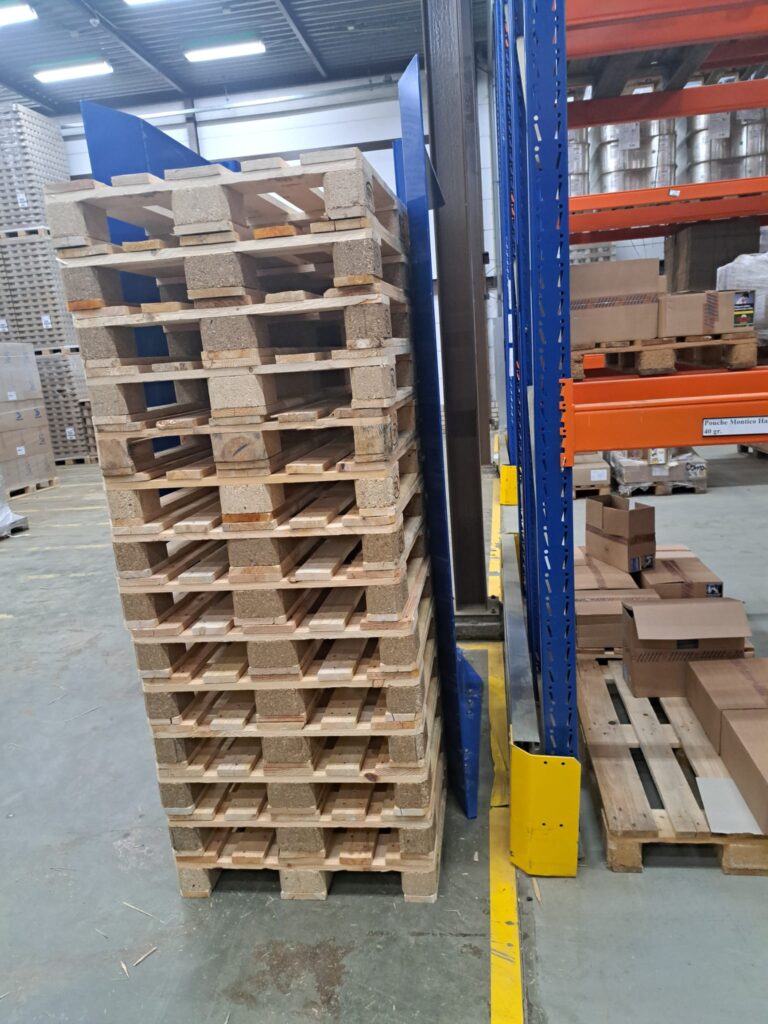
Knowledge base
What is a pallet straightener?
A pallet straightener is a free-standing steel frame in which you place a stack of empty pallets with a forklift and push it in…
Read more -
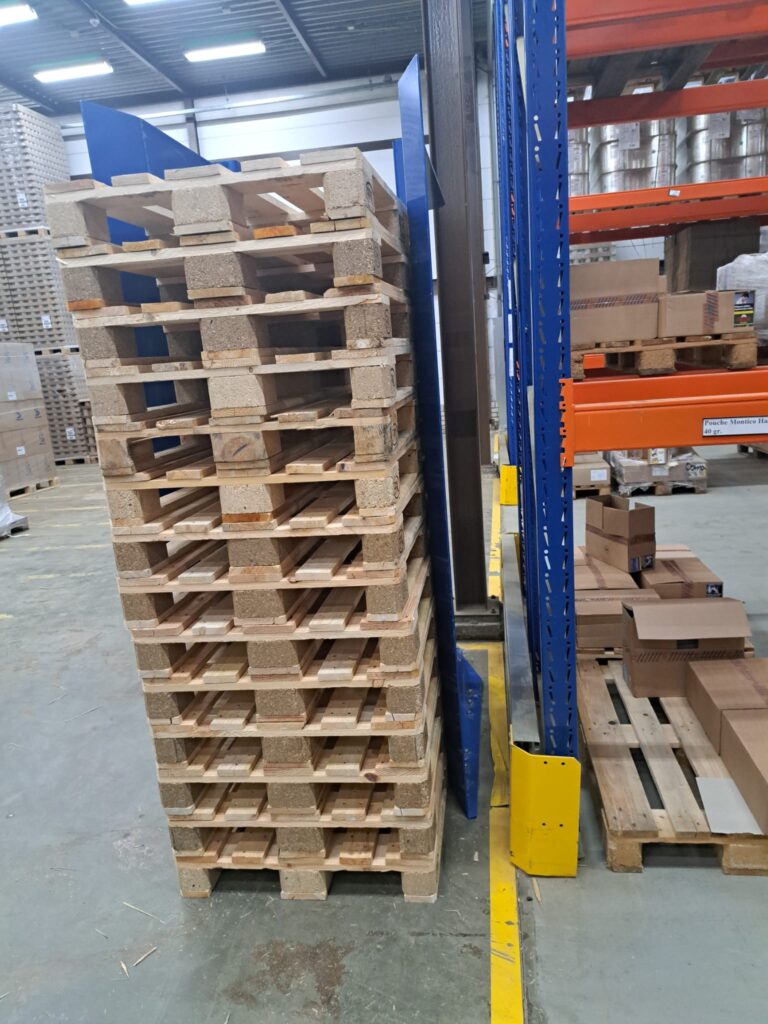
Blog
Empty pallets at the palletiser: supply without leaning stacks
You supply empty pallets to the palletiser without leaning stacks by making sure every stack is straight before it reaches the line. In a…
Read more -
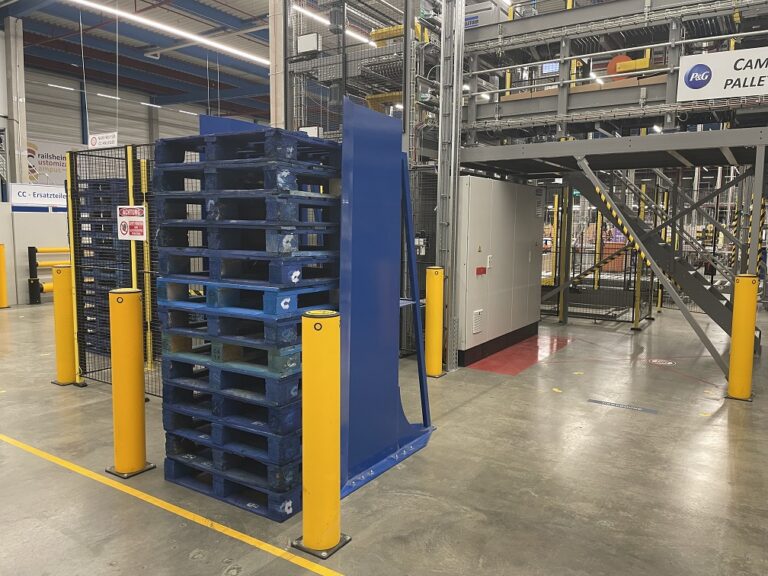
Product line
Palletframe Auto
Palletframe Auto is a pallet stack straightener: a free-standing steel frame with a deeper lead-in funnel. You place the stack of empty pallets in…
Read more
Questions about stacking empty pallets?
We are happy to help. Request a no-obligation quote or ask us your question.