

Post
Empty pallets at the palletiser: supply without leaning stacks
You supply empty pallets to the palletiser without leaning stacks by making sure every stack is straight before it reaches the line. In a pallet straightener, you press a crooked stack straight with your forklift; then you take the straight stack to the palletiser or leave it ready in the frame.
By Palletframe editorial team Published Updated
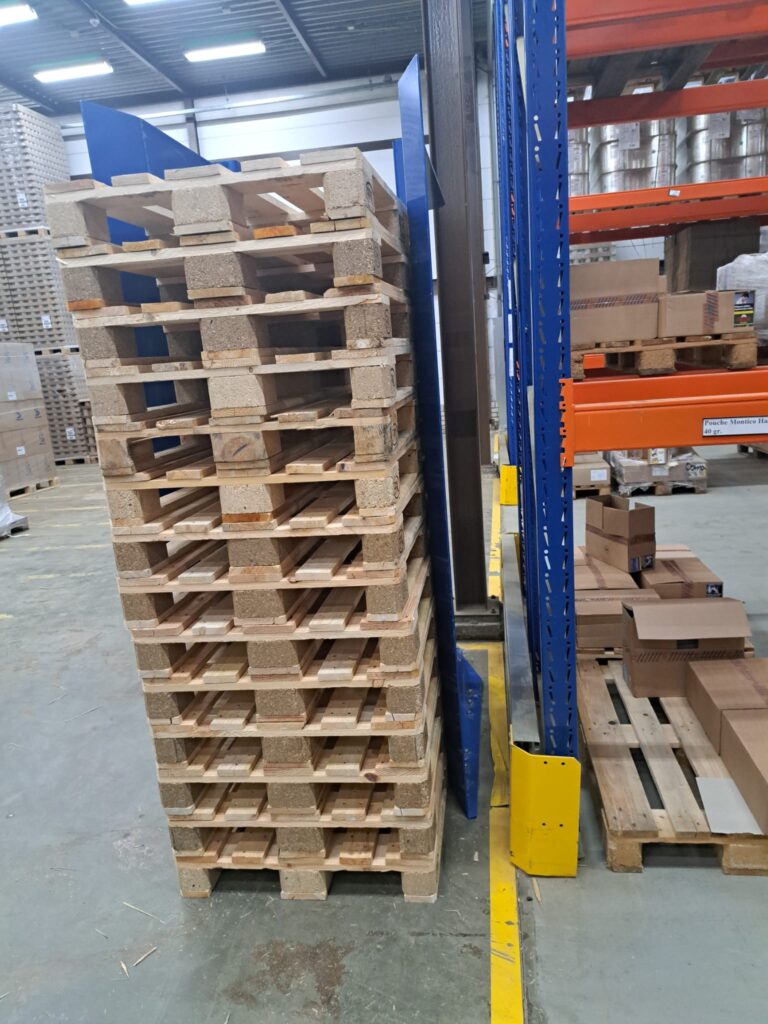
At the end of a production line, a palletiser places boxes, sacks or crates onto a pallet. To do that, the line needs a steady supply of empty pallets. A leaning stack, or a pallet that does not sit properly, can hold up that supply.
This article explains why leaning stacks hold up the line, how to supply empty pallets to it and how you press stacks straight with a pallet straightener before they go to the palletiser.
Why leaning stacks hold up the line
A palletiser usually expects the empty pallet in a fixed position, so that the machine can place the layers properly. If the line is fed from a stack of empty pallets, it matters how that stack stands.
A leaning stack can cause delays in several ways:
- a pallet that comes off the stack at an angle does not sit properly on the infeed and has to be put right first;
- a crooked stack, with pallets sticking out on the left and right, does not fit in the palletiser;
- the forklift driver has to rebuild the stack first, which takes time at a moment when the line is waiting;
- a leaning stack can fall over next to a line where people are working.
Leaning stacks can arise before the line: when pallets are stacked after use, during transport, or in a cramped place where stacks are pushed against each other or against a wall. A straight supply therefore starts with a straight stack. How to stack pallets straight is explained in Stacking empty pallets: straight, stable and safe.
Also pay attention to the pallets themselves. A damaged pallet, or a pallet of a different size in between the rest, makes a stack lean and can cause delays at the line. So take such pallets out when stacking, and keep different pallet sizes on separate stacks.
Supplying the line
When the forklift brings empty pallets to the palletiser as a stack, that stack has to be straight. Two things matter here: how the stack gets to the line, and how it is made straight.
Manual, with a forklift
The forklift driver takes a stack of empty pallets from storage and sets it down at the supply point by the line. This approach is flexible and needs no extra machine. The drawback: the supply depends on the driver and on how the stack stands.
With manual supply, it helps to agree when the driver brings a new stack, for example at set times or at every shift change. Then the next stack is ready before the line has to wait.
Press the stack straight first
Before the stack goes to the line, you press it straight in a pallet straightener. The driver places the crooked stack in the frame, pushes it in with the forklift and then takes the straight stack to the palletiser. A straight stack fits in the palletiser; a crooked one, with pallets sticking out, does not.
There is always a moment when a stack of empty pallets is waiting by the line. At that moment, the stack has to be straight, and in a place where the driver can pick it up quickly.
Match the stack changes to the rhythm of the shifts, too. For example, agree that the outgoing shift leaves a straight stack ready, so the new shift does not start with an empty supply point. Set out in the work instruction who keeps an eye on the supply and who sets a leaning or damaged stack aside before it reaches the line.
Straight stacks for the palletiser with a pallet straightener
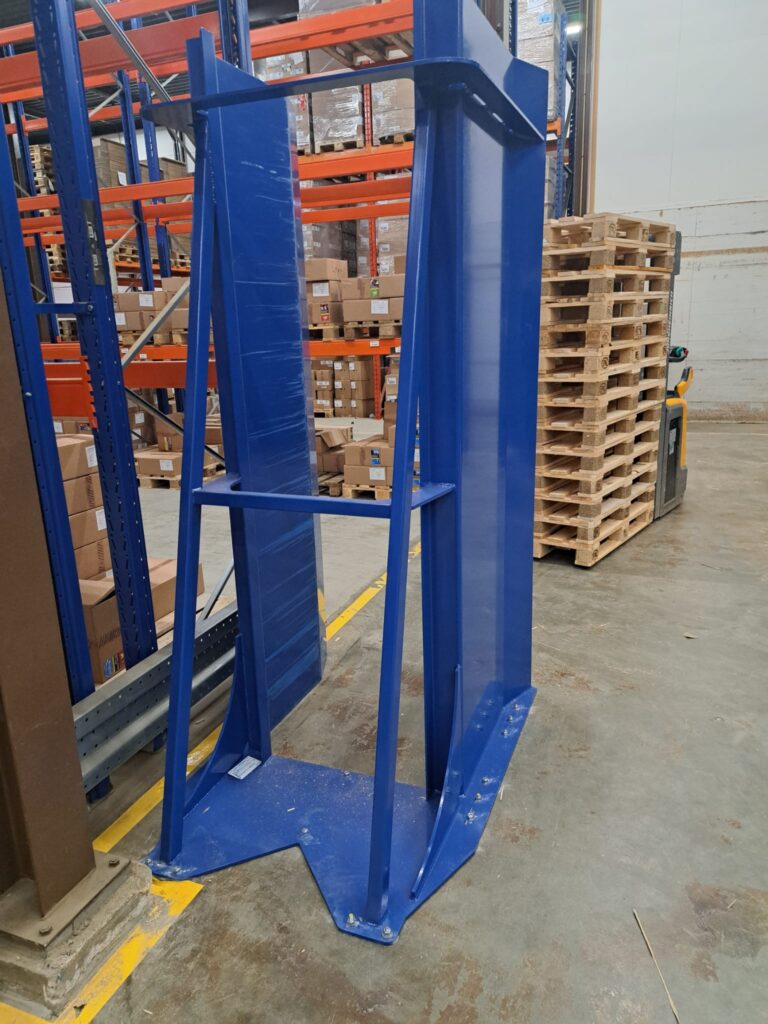
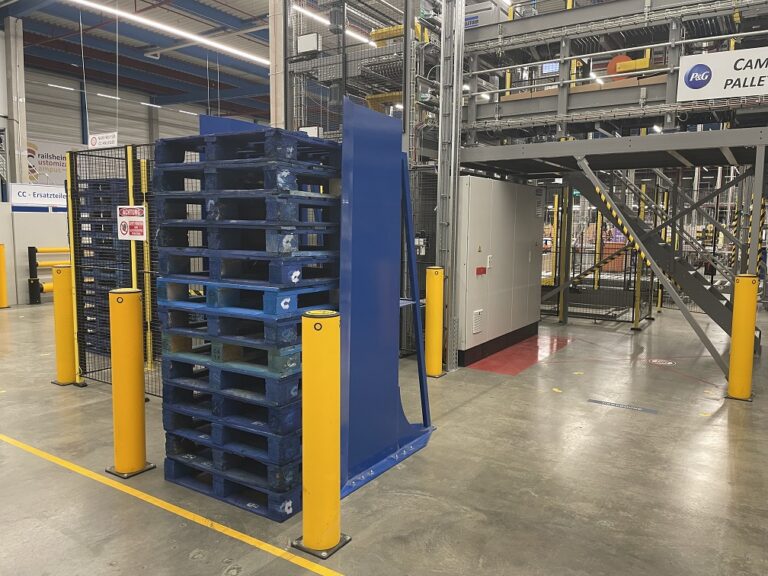
A pallet straightener is a free-standing steel frame in which you press a stack of empty pallets straight with a forklift. At a palletiser, the frame can also be the fixed place where the next stack, already pressed straight, stands ready.
A pallet straightener by the line helps in several ways:
- the driver knows exactly where the next stack has to go;
- every stack is pressed straight before it goes into the palletiser;
- a stack can be ready for the next change;
- stacks no longer stand loose next to the line, where people work and walk.
Choose the place so that the forklift can drive straight up to it, outside the walkway along the line and close enough to the infeed to avoid a detour. Mark the place on the floor, so that a relief driver also knows where the stack belongs.
Auto with lead-in funnel
Palletframe Auto has a deeper lead-in funnel, which makes the stack straighter. The forklift drives the stack into the frame, the funnel centres the pallets and pushing the stack in presses it straight. Like every Palletframe, the Auto works without any drive or power.
Palletframe Auto comes in three pallet widths and is also available made to measure:
| Model | Article number | Pallet width | Height |
|---|---|---|---|
| Palletframe Auto A800 | 13002028 | 800 mm | 2,350 mm |
| Palletframe Auto A1000 | 13002027 | 1,000 mm | 2,350 mm |
| Palletframe Auto A1200 | 13002030 | 1,200 mm | 2,350 mm |
| Palletframe Auto made to measure | — | on request | on request |
Every frame is blue as standard and available in another colour or galvanised as an option. Alongside the Auto there is Palletframe Basic, the standard model, in the same widths and height.
One thing remains important: check the pallets themselves. Pressing a stack straight does not repair a damaged pallet or replace a pallet of a different size, so take those out when stacking.
Empty pallet stacker or pallet straightener?
What is sold as an empty pallet stacker is really a pallet dispenser: the operator takes a pallet out or puts one back. A pallet straightener is a free-standing steel frame in which you press a stack of pallets straight with a forklift. Choose an empty pallet stacker when operators constantly need a new pallet; choose a pallet straightener when stacks of pallets need to be pressed straight.
How they compare is set out in the article Pallet straightener or empty pallet stacker.
Not sure which solution suits your line? Describe how empty pallets arrive and which pallet sizes you use, and we will help you choose. Request a no-obligation quote.
Frequently asked questions
Another question?
We are happy to help.
How do you feed empty pallets to a palletiser?
With a forklift, as a stack. Make sure that stack is straight before it reaches the line: in a pallet straightener, you press a crooked stack straight with the forklift, so it fits in the palletiser.
Empty pallet stacker or pallet straightener at the line?
What is sold as an empty pallet stacker is really a pallet dispenser: choose it when operators constantly need a new pallet. Choose a pallet straightener when stacks of pallets need to be pressed straight, for example so they fit in the palletiser. See the article Pallet straightener or empty pallet stacker.
Which Palletframe suits a palletiser?
That depends on your pallets and the situation at the line. First choose the pallet width: 800, 1,000 or 1,200 mm, or made to measure. Palletframe Auto has a deeper lead-in funnel, which makes the stack straighter. In Palletframe Basic, the standard model, you also press the stack straight with your forklift. We are happy to discuss which model suits your situation. Request a quote.
Palletframe editorial team
This article was written by the Palletframe editorial team, based on Allmarec’s product data and hands-on experience.
-

Product
Palletframe Auto A1200
The Palletframe Auto A1200 is a pallet straightener for stacks of empty pallets with a pallet width of 1,200 mm: a free-standing steel frame,…
Read more -
Knowledge base
Pallet straightener or empty pallet stacker: which suits your empty pallets?
An empty pallet stacker is really a pallet dispenser: operators take a pallet out or put one back. A pallet straightener is a free-standing…
Read more -
Product line
Palletframe Auto
Palletframe Auto is a pallet stack straightener: a free-standing steel frame with a deeper lead-in funnel. You place the stack of empty pallets in…
Read more
Questions about stacking empty pallets?
We are happy to help. Request a no-obligation quote or ask us your question.