

Post
Empty pallets in food production: order and hygiene
You keep empty pallets in food production orderly and clean by storing them in a zone of their own, away from production and separate from dirty or damaged pallets. Give every stack a fixed place there, for example in a pallet straightener, so the floor around it is easy to keep clean.
By Palletframe editorial team Published Updated
In a food business, hygiene and order come first. Empty pallets are simply part of it: raw materials arrive on them and finished products leave on them. At the same time, a stack of empty pallets can bring in dirt and dust and get in the way of cleaning.
This article explains which rules apply to safe food handling, how to keep empty pallets separate and orderly, and how a fixed place helps to keep the floor clean.
Empty pallets and hygiene
GOV.UK guidance for food businesses says that if you run a food business, you need a food safety management system to make sure your food is safe to eat, and that this system must meet the Hazard Analysis and Critical Control Point (HACCP) principles (Food safety management systems for businesses, GOV.UK). Among the parts of such a system, the guidance lists safe cooking and storage procedures.
In Ireland, the Food Safety Authority of Ireland (FSAI) describes three ways to meet the HACCP requirement: complying with the basic hygiene rules in the legislation, which may be enough for low-risk businesses; following a recognised guide to good practice; or developing a formal HACCP system, which is usually required of large businesses (Meet HACCP Requirements, FSAI).
Neither source mentions pallets separately. Empty pallets are not food, but they are in your premises. So it makes sense to cover empty pallets in the procedures that follow from your food safety management system. What those procedures say about empty pallets is for you to decide, together with your quality manager.
So where do empty pallets cause problems? They often come from outside: from suppliers, from hauliers or from the returns flow. They can be dirty, wet or damaged. A loose stack in a corner also traps dust and dirt, and the floor under and around it is hard to clean.
Separate zones for empty pallets
A first step is separation. Give empty pallets a zone of their own, away from the areas where unpackaged food is handled. Agree on the following:
- which pallets go in which zone, for example clean pallets for reuse separate from pallets waiting to be returned or collected;
- that dirty, wet or damaged pallets are set aside straight away, for repair, cleaning or disposal;
- in which areas empty pallets are allowed, for example only at goods-in and dispatch;
- who decides whether a pallet is clean enough to use again.
Mark the zones on the floor and give them a clear name. That way everyone, including a new employee or an agency worker, knows where a pallet belongs. Also agree who checks the zones and how often. How to store empty pallets without racking, and how loose stacks, block stacking and a frame differ, is explained in Empty pallet storage without racking.
The location in the building counts as well. Ideally, keep empty pallets close to goods-in or dispatch, where they come in and are needed again. Then they do not have to pass through areas where unpackaged food is handled. Also agree how pallets move from one zone to another, for example through which door and with which forklift, so that a dirty pallet does not end up in a clean zone unnoticed. More about setting up storage in the building in Stacking empty pallets in a warehouse.
A fixed place, a clean floor
A stack in a fixed place is easier to keep clean than stacks scattered around the building. You know where they are, how much space they take and how to clean around them.
Tips for a clean storage place:
- leave space between the stacks and the wall, so you can clean along it;
- do not put stacks in corners that are hard to reach;
- include the storage place in the cleaning schedule;
- make sure the stacks are straight, so no pallets stick out at an angle or fall over;
- remove damaged pallets and loose boards straight away.
Include the storage place in your regular hygiene checks as well. Look, for example, for damp, mould, loose pieces of wood and signs of pests, on the pallets and on the floor around them. A storage place with straight stacks and space around them is easier to check than a corner full of loose stacks.
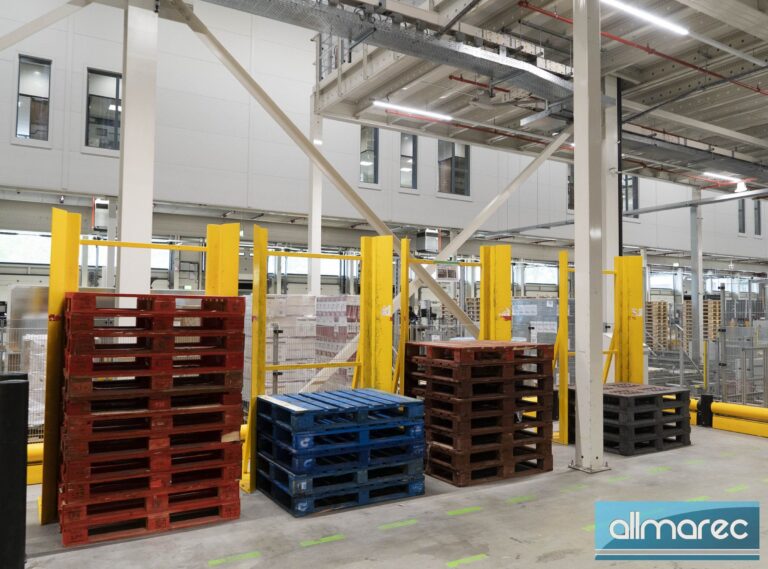
A pallet straightener can help with that. It is a free-standing steel frame in which you press a crooked stack of empty pallets straight with your forklift. The straight stack can then stay in the frame, in a fixed, recognisable place. The stacks stay within the zone and everyone can see right away where empty pallets belong. A row of frames also makes it clear how much space the storage takes up and which floor you keep clean around it.
Palletframe Basic is the standard model: 2,350 mm high, for a pallet width of 800, 1,000 or 1,200 mm. What else a pallet straightener does for your floor and your stacks is explained under Benefits of a pallet straightener.
Finish: blue or galvanised
Every Palletframe is blue as standard. As an option, the frame is available in another colour or galvanised, in every line: Basic, Auto and Specials. If your pallet size is different, a made-to-measure frame is possible.
| Version | What you choose |
|---|---|
| Standard | blue |
| Option | another colour |
| Option | galvanised |
| Made to measure | every line to measure, on request |
Another colour can help to keep zones apart, for example one colour for clean pallets and another for pallets waiting to be returned. We are happy to discuss which version suits your business.
Keep in mind what the frame is for: pressing stacks of empty pallets straight, and giving them a place if you leave them in it. For the hygiene of the storage place, the procedures in your food safety management system still take precedence.
Not sure which frames and finish suit your business? Request a no-obligation quote.
Frequently asked questions
Another question?
We are happy to help.
Where do you keep empty pallets in a food plant?
In a marked zone of their own, away from the areas where unpackaged food is handled, ideally close to goods-in or dispatch. Keep clean pallets separate from dirty, wet or damaged ones and give every stack a fixed place.
What hygiene rules apply to pallets?
Neither the GOV.UK nor the FSAI guidance mentions pallets separately. In the UK, a food business needs a food safety management system that meets the HACCP principles (GOV.UK); in Ireland, the FSAI describes three ways to meet the HACCP requirement (FSAI). Include the handling of empty pallets in your system and ask your quality manager if in doubt.
Is a pallet straightener available galvanised?
Yes. Every Palletframe is blue as standard and available in another colour or galvanised as an option, in every line: Basic, Auto and Specials.
Palletframe editorial team
This article was written by the Palletframe editorial team, based on Allmarec’s product data and hands-on experience.
-
Knowledge base
Empty pallet storage without racking
For empty pallet storage you do not need racking: you can use loose stacks, block stacking on the floor or a pallet straightener. Block…
Read more -
Blog
Empty pallets in a distribution centre: dock, buffer zone and floor space
Empty pallets in a distribution centre do not belong on the dock, but in a fixed buffer zone just behind the loading bays, away…
Read more -

Product line
Palletframe Basic
Palletframe Basic is a free-standing steel pallet stacking frame: you place a stack of empty pallets in it with a forklift and push it…
Read more
Questions about stacking empty pallets?
We are happy to help. Request a no-obligation quote or ask us your question.