

Post
Pallet management: exchange, records and losses
Pallet management means keeping track of how many pallets you receive, hand over and exchange, with whom, and where they end up. Record every exchange in a pallet account per business partner and count empty pallets in a fixed place, so you spot differences in time and keep losses down.
By Palletframe editorial team Published Updated
Every pallet that enters or leaves your business has a value. Even so, pallets easily drop out of sight: they leave with a load, stay at a customer’s site or get damaged. Pallet management is the set of arrangements and records that keeps you in control.
This article explains how pallet exchange works, how to keep a pallet account, where pallets get lost and why a fixed place makes counting easier.
How pallet exchange works
With pallet exchange, the parties agree that empty pallets are handed back instead of paid for. For example, if a haulier delivers ten pallets of goods to you, the agreement may be that you give the driver ten empty pallets to take away. Exactly how that works depends on the agreement.
Whether and how pallets are exchanged is decided by the parties together: shipper, haulier and consignee. Put the agreement in writing, for example in the contract with your haulier or in your terms of delivery. In any case, agree:
- which pallets are exchanged, and which are not;
- when the exchange takes place: at delivery or later;
- what quality a pallet must have to count as an exchange pallet;
- what happens if there are not enough empty pallets ready at a delivery.
Exchanging EPAL Euro pallets
For EPAL Euro pallets, the European Pallet Association (EPAL) has its own Terms of Exchange and a quality classification. The classification distinguishes new pallets and used pallets in class A, B and C. Parties can use it to agree which quality they deliver and get back. If no class is agreed, the EPAL Terms of Exchange apply. According to EPAL, unsorted EPAL pallets are exchanged one-to-one (EPAL news item on the quality classification and the Terms of Exchange).
If you also exchange other pallets, such as pallets in a different size or one-way pallets, agree for each type whether they are exchanged. That avoids discussion afterwards.
Keeping pallet records
A pallet account is an overview, per business partner, of the pallets you have received and handed over. The balance shows who owes pallets to whom. If you do not exchange at every delivery, you need such an account to know where you stand.
What do you record for each movement?
- the date and the business partner: haulier, customer or supplier;
- the number and type of pallets that came in and went out;
- the quality, if you have agreed terms for it;
- a confirmation from the driver or the consignee, for example a signature on the delivery note or a pallet note.
Reconcile the balance with your business partners regularly, for example every month. The longer you wait, the harder it is to trace a difference. A difference you spot early can still be checked against the notes from that period.
A count of your own stock is part of it. At a fixed moment, count how many empty pallets there are in your building and in your yard, and compare that with what the records say. Only then do you know whether the pallet account matches reality.
Also make it clear who manages the pallet account. Appoint one person or department to collect the notes, update the balance and discuss differences with business partners. Without a clear owner, notes are soon left lying around and you only notice differences late. Whether you keep the account in a spreadsheet or a system matters less than doing it consistently.
Where pallets get lost
Pallets can drop out of sight at many moments, often a few at a time. Watch out for these moments in particular:
- Exchanges that are not recorded: different numbers are exchanged than agreed, and nobody writes it down.
- Exchanges in a different quality: good pallets go out and damaged pallets come back.
- Pallets that stay with customers: they go out with a shipment and do not come back, although that was not agreed.
- Disposal without records: damaged pallets are thrown away or sold without it being recorded.
- Scattered stock: empty pallets are spread around the building and the yard, so the count does not add up.
Have more empty pallets than you need, or pallets you no longer use? There are companies that collect, buy or repair empty pallets. Record that kind of removal as well, so the pallet account and the count stay correct.
A difference on the pallet account is not always a loss. Sometimes a note has gone missing, or a stack is standing somewhere nobody looked. So investigate a difference before you write it off, and check whether it always arises with the same business partner or at the same moment.
A fixed place makes counting easier
Counting is quickest when all empty pallets stand in a fixed place, in straight stacks and separated by type. If stacks are scattered around the building, behind the dock and in the yard, you will soon miss a few in the count.
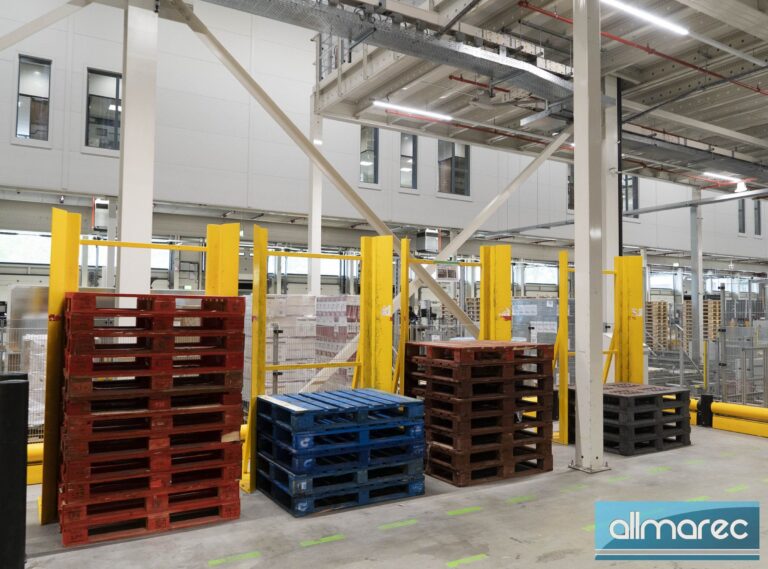
A pallet straightener helps to set up that fixed place. It is a free-standing steel frame in which you press a stack of empty pallets straight with a forklift. You can leave the straight stack in the frame, so each stack has its own place. If you put frames side by side, you can see at a glance how many stacks there are and which frames still have space.
For counting, one rule matters most: empty pallets stand only in the fixed place, and they are counted at a fixed moment, for example at the end of the week. How to set up such a place, with a separate area per type and a separate place for damaged pallets, is explained in Empty pallet storage without racking.
Palletframe comes in three lines: Basic, Auto and Specials. You can see all models, with pallet widths and heights, in the product overview. For the place by the dock, see Empty pallets in transport and logistics and Empty pallets in a distribution centre.
Questions about a fixed place for your empty pallets? Get in touch.
Frequently asked questions
Another question?
We are happy to help.
How does pallet exchange work?
With pallet exchange, the parties agree that empty pallets are handed back instead of paid for, for example that you give the haulier who delivers your goods empty pallets to take away. Exactly how that works depends on the agreement; put it in writing. For EPAL Euro pallets, the EPAL Terms of Exchange apply; according to EPAL, unsorted EPAL pallets are exchanged one-to-one.
How do you keep track of pallets?
Keep a pallet account per business partner with the pallets you receive and hand over, and have every movement confirmed, for example on the delivery note. Reconcile the balance regularly and compare it with a count of your own stock in a fixed place.
Where do pallets get lost?
For example in exchanges that are not recorded, exchanges in a poorer quality, pallets that stay with customers and damaged pallets that are disposed of without records. Empty pallets that are scattered around also make the count unreliable.
Palletframe editorial team
This article was written by the Palletframe editorial team, based on Allmarec’s product data and hands-on experience.
-
Knowledge base
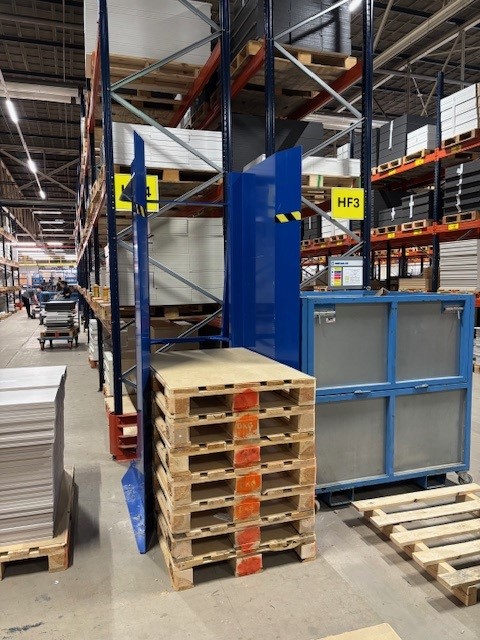
Empty pallet storage without racking
For empty pallet storage you do not need racking: you can use loose stacks, block stacking on the floor or a pallet straightener. Block…
Read more -
Blog
Empty pallets in a distribution centre: dock, buffer zone and floor space
Empty pallets in a distribution centre do not belong on the dock, but in a fixed buffer zone just behind the loading bays, away…
Read more -

Product line
Palletframe Basic
Palletframe Basic is a free-standing steel pallet stacking frame: you place a stack of empty pallets in it with a forklift and push it…
Read more
Questions about stacking empty pallets?
We are happy to help. Request a no-obligation quote or ask us your question.